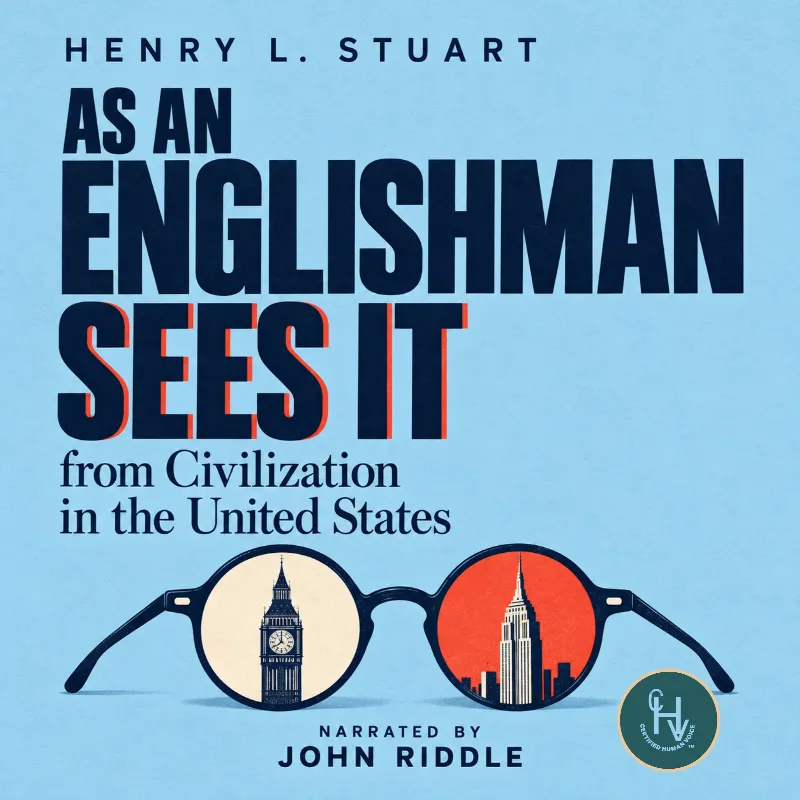
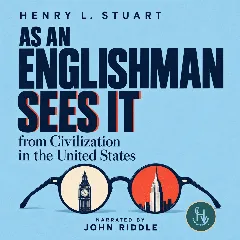
A bracing, clear-eyed tour of America through British eyes, As An Englishman Sees It weighs the promise and perils of a nation in the wake of war and on the cusp of modernity.
Hear it read by JOHN RIDDLE: the audiobook is right here
Story guide on this page: summary, characters, discussion questions
Yours to keep: a DRM-free EPUB for any device. Read it here, or on Kindle (with Send to Kindle), Apple Books, Kobo or Google Play Books.
Want both? Buy the audiobook and add the ebook for $0.99.
Free audiobook
Listen to the whole story free
Enter your email and we'll send you a link to the full audiobook of As An Englishman Sees It (from Civilization in The United States). No account needed.
We'll also ask if you'd like new audiobooks by email. Privacy Policy
✓ DRM-free, yours to keep. Download the files after you buy and play them anywhere.
Yours to keepBuy once, it stays in your library
Listen anywhereIn our app on your phone or computer
Bought by mistake, or something wrong with the file? Email apica@academyvoices.com within 14 days for a full refund.
Bought by mistake or something wrong with the audio? Email apica@academyvoices.com within 14 days for a full refund.
About this audiobookAbout this book
A bracing, clear-eyed tour of America through British eyes, As An Englishman Sees It weighs the promise and perils of a nation in the wake of war and on the cusp of modernity. Henry L. Stuart begins with a striking scene in Paris and expands it into a provocative thesis: the United States and Great Britain march to the same tune at different tempos. From America’s love of scale, speed, and efficiency to England’s stubborn affection for the small, the local, and the human, Stuart probes how style becomes substance—shaping politics, work, class, and even the language of leadership. He examines the cult of productivity, the new gospel of welfare and uplift, house organs and sales pep, and the fragile bond between the two nations when sympathy is grounded in class rather than people. With sharp wit and prescient insight, he asks what happens when a disciplined, production-driven society meets a restive, tradition-steeped proletariat—and whether Anglo-American unity can survive the strains of power, pride, and competing ideals. Narrated with an engaging, conversational clarity by John Riddle, this essay is essential listening for fans of cultural criticism, American studies, and history that still speaks to today.
Story guide
As An Englishman Sees It (from Civilization in The United States) summary
Spoiler alert: this summary tells the whole story.
Henry L. Stuart begins on July 14, 1919, in Paris, where he watches the Allied victory parade from a hotel balcony as a British officer. The contingents march in alphabetical order, so the Americans lead: tall, spotless, drilled to machine-like precision, and to Stuart the most impressive sight of the day. Then, from the next balcony, where a group of ordinary British clerks and typists stand, he hears something shocking. They are hissing the Americans. A senior officer shrugs it off: the Americans were "slopping over," going a little too far, a bit out of step. Stuart decides that homely phrase gets closer to the real difference between the two peoples than any learned study.
He argues that talk of a shared Anglo-Saxon bond is mostly empty after-dinner speech. Few English workers come to America, and famous English visitors see only the comfortable side of American life. Since the war, gold and power have been flowing from Britain to America, and Britain faces a choice between rival paths, one of them revolution. Britain's ruling classes now admire America as a model of order and production, but Stuart warns that this friendship rests on class, not on the feelings of the British people. English working men show no enthusiasm for America.
The heart of the essay is a contrast in temperament. The Englishman, Stuart says, is stubbornly individual and unimpressed by size. He loves little things, roots for David over Goliath, and loved the small "contemptible" army more than the great steel navy. The American loves bigness: "Big Bill," Babe Ruth, Jack Dempsey, and huge efficient enterprises. Teaching waves of immigrants has forced American ideas into simple drill-book terms. Stuart describes American business as a jealous religion of production, with company magazines, "punch," "red-blooded men," efficiency charts and welfare programs that claim the worker's whole life. In England a fair day's work for a fair wage still marks a line between work and spirit; in America, he says, that frontier is gone.
Stuart concludes that Americans currently accept the demands of commerce while the English revolt against them. In America, rebels are crushed and immigrants told to "go back." The English worker, who built the Empire and was promised much during the war, will not be so easily driven, and when he gains real power no one will be able to sell him the American gospel of work. History shows, Stuart ends, that excess of any kind has always challenged the English, whose struggle has always been for a "balance of power" and against "slopping over."
The essay is a vivid outsider's view of America just after World War I, and a frank reminder that even close allies can see each other very differently.
Famous lines
On this great day of international congratulation, one of the two branches of the Anglo-Saxon race was hissing the other.
Henry L. Stuart, at the Paris parade
To achieve discord, you see, it is not necessary that two instruments should play different tunes. It is quite sufficient that the tempo of one should differ from the tempo of the other.
Henry L. Stuart
I know no other country where the word “big” is used so constantly as a token of affection.
Henry L. Stuart
Main characters
HL
Henry L. StuartThe author, an Englishman who served as an officer in the war and spent twenty years between England and the United States.
FC
The former chiefA senior British officer who dismisses the hissing by saying the Americans were "slopping over."
BC
The British clerksOrdinary English office workers on the next balcony who hiss the American troops.
Did you know?
Civilization in the United States was a famous 1922 collection of essays on American life, edited by the critic Harold Stearns.
The victory parade Stuart describes was held on July 14, 1919, Bastille Day, the French national holiday, with Allied troops marching through the Arc de Triomphe.
The Battle of Jutland in 1916, which Stuart remembers hearing about in an artillery camp, was the largest naval battle of World War I and the only full clash of the British and German battle fleets.
Questions to talk about
Why do you think the British clerks hissed the American troops at a celebration of victory?
What does "slopping over" mean, and why does Stuart think it explains the difference between the two peoples?
Stuart says the English love little things and Americans love bigness. Can you find examples of each today?
Why does he describe American business as a kind of religion? Is his picture fair?
He warns that the Anglo-American friendship rests on class, not on ordinary people. What would change his prediction?
New listeners
Get 25% off your first audiobook
Join our list and we'll email you 25% off, plus new releases from our store. Every one is read by a real person. No account needed.
Details
Length
1 hr 2 min
Narration
Solo narrator
Format
Unabridged audiobook
Publisher
Anthony Pica Productions LLC
Language
English
ISBN
9798179302193
Questions
What is As An Englishman Sees It (from Civilization in The United States) about?
An English officer and journalist who had lived for years in both countries explains, starting from a moment at the 1919 Paris victory parade, why he thinks the British and American characters keep falling out of step.
Who are the main characters in As An Englishman Sees It (from Civilization in The United States)?
Henry L. Stuart, the author, an Englishman who served as an officer in the war and spent twenty years between England and the United States; The former chief, a senior British officer who dismisses the hissing by saying the Americans were "slopping over."; The British clerks, ordinary English office workers on the next balcony who hiss the American troops.
Who narrates the As An Englishman Sees It (from Civilization in The United States) audiobook?
This edition of As An Englishman Sees It (from Civilization in The United States) by Henry L. Stuart is narrated by JOHN RIDDLE.
How long is the As An Englishman Sees It (from Civilization in The United States) audiobook?
It runs 1 hr 2 min, unabridged, so you hear the complete text.
Is this audiobook narrated by a real person?
Yes. Every Academy Voices audiobook is Certified Human Voice: performed start to finish by a real narrator.
Where can I listen to As An Englishman Sees It (from Civilization in The United States)?
Right here: buy it on Academy Voices and listen in your browser or our app. Hear a free sample on this page first.