Hear it read by Jennifer Sward: the audiobook is right here
Story guide on this page: summary, characters, discussion questions
Yours to keep: a DRM-free EPUB for any device. Read it here, or on Kindle (with Send to Kindle), Apple Books, Kobo or Google Play Books.
Want both? Buy the audiobook and add the ebook for $0.99.
✓ DRM-free, yours to keep. Download the files after you buy and play them anywhere.
Yours to keepBuy once, it stays in your library
Listen anywhereIn our app on your phone or computer
Bought by mistake, or something wrong with the file? Email apica@academyvoices.com within 14 days for a full refund.
Bought by mistake or something wrong with the audio? Email apica@academyvoices.com within 14 days for a full refund.
About this audiobookAbout this book
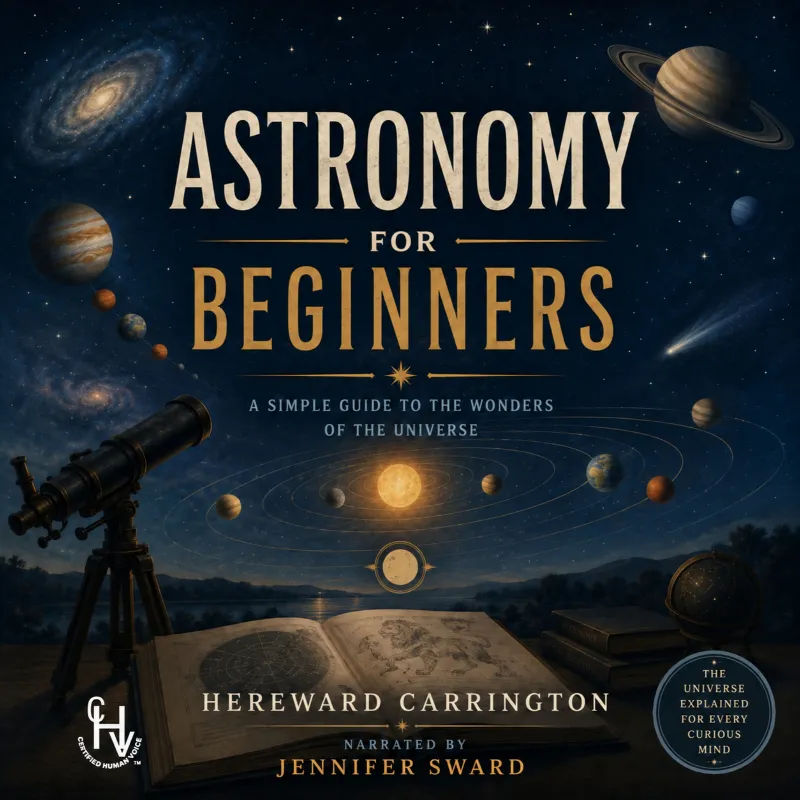
What is the Sun made of? How far away are the stars? Why do shooting stars fall? This 1925 introduction takes the beginner on a tour of the sky, from the solar system and each planet to the Moon, comets, the Milky Way, eclipses and telescopes.
Hereward Carrington wrote it as a Little Blue Book in plain, non-technical language, with homely comparisons to make huge distances easier to picture. It is read by Jen Sward. Ninety-six minutes.
For listeners who want a friendly overview of the heavens, from an earlier era of astronomy.
Story guide
Astronomy for Beginners summary
Spoiler alert: this summary tells the whole story.
Hereward Carrington opens by explaining the difference between astronomy and astrology. Astronomy, he says, studies the heavenly bodies by scientific means, while astrology's claim that the planets shape our lives has no scientific basis. He then gives a vivid scale model of the solar system: if the sun were a two-foot globe on an open common, the Earth would be a pea about 215 feet away and Neptune a plum more than a mile off.
The heart of the book is a tour of the solar system. Carrington describes the sun's layers, its huge flaming prominences and the eleven-year sunspot cycle. He visits each planet in turn, from tiny Mercury to distant Neptune, with sizes, distances and years. He tells the story of how Adams and Leverrier found Neptune by mathematics before anyone saw it, and wonders whether another planet lies beyond. He describes the moon's craters and phases, the asteroids, comets such as Halley's, which caused a scare in 1910, and meteorites. He also explains theories of how the solar system formed, from Laplace's spinning cloud of gas to newer ideas of his own day.
The second half moves out to the stars: constellations, the Milky Way, nebulae, light-years, double, colored and variable stars, and stars that suddenly flare up and fade. Carrington explains how eclipses work, recalling the total eclipse of January 1925, and how telescopes, the spectroscope and photography let astronomers learn what distant stars are made of. Short sections cover tides, gravitation, lightning, the northern lights, time zones and the calendar, and the cold and darkness of space. The book ends with a list of definitions.
Written in 1925, the book is also a snapshot of what scientists believed a century ago. Some of it has since changed. Pluto had not yet been found, the "canals" of Mars were still being debated, and many scientists still spoke of an invisible "ether" filling space. Readers today can enjoy it both as a friendly introduction to the night sky and as a window into the history of science.
Famous lines
Astronomy studies the heavenly bodies, and their movements, etc., by all available scientific means;
Hereward Carrington
The earth would appear an insignificant speck of dust, in this vast, roaring furnace of flame!
Hereward Carrington, on the sun
So vast are these distances that some simple means of expressing them on paper was sought.
Hereward Carrington, on the light-year
Main characters
HC
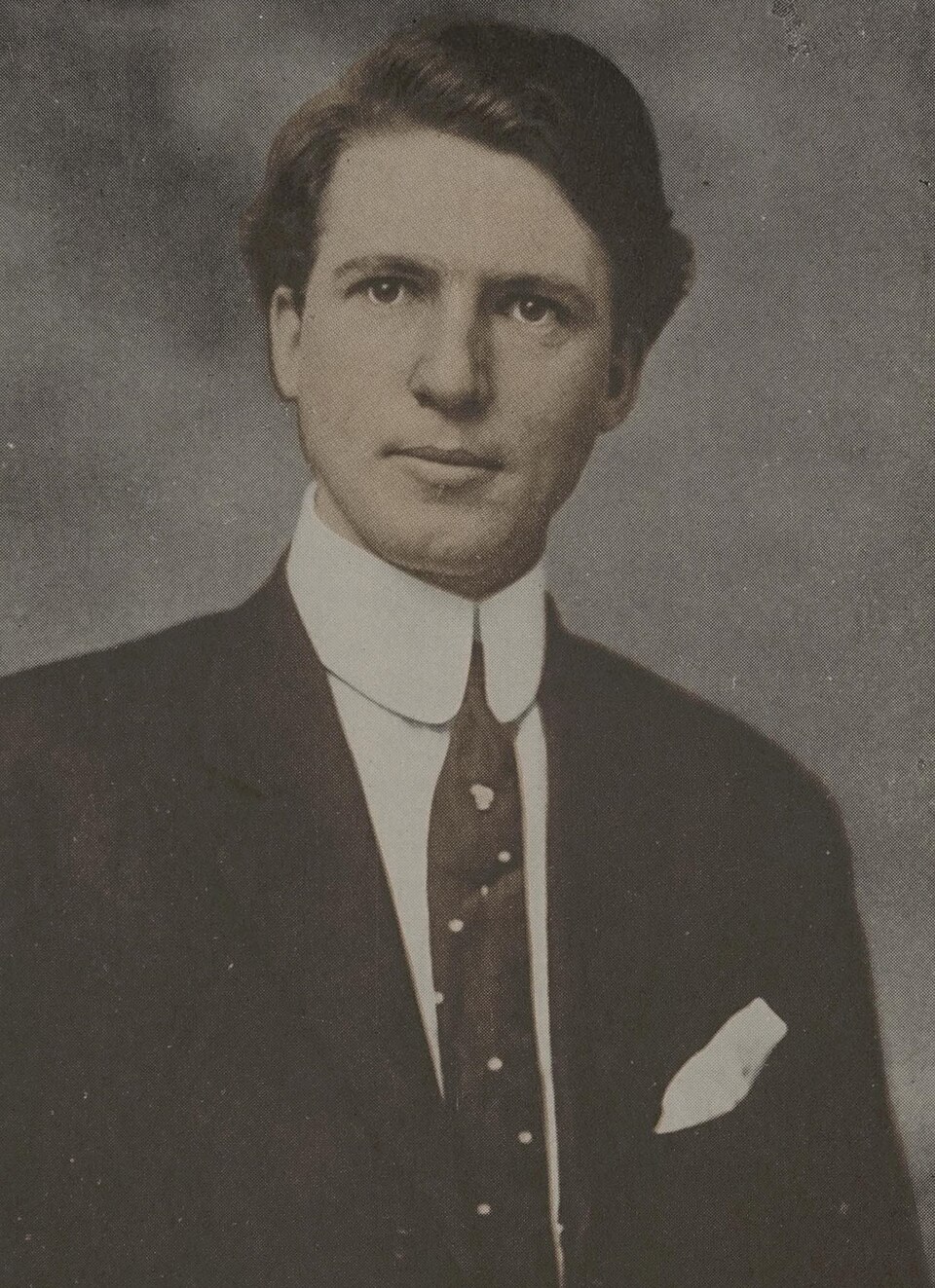
Hereward CarringtonThe author, a popular writer on science and psychical research who acts as a friendly guide.
JC
John Couch Adams and Urbain LeverrierMathematicians who each predicted where Neptune would be found.
PL
Percival LowellThe American astronomer who studied the so-called canals of Mars from Flagstaff, Arizona.
PL
Pierre-Simon LaplaceThe French scientist whose 1796 theory tried to explain how the solar system formed.
GE
George Ellery HaleThe astronomer who in 1908 showed that sunspots act as magnetic centers.
Did you know?
Little Blue Books were small, cheap paperbacks sold by the millions from Girard, Kansas, to bring learning to ordinary readers.
Pluto was discovered in 1930, five years after this book wondered whether another planet lay beyond Neptune.
Hereward Carrington was best known as an investigator of psychic and spiritualist claims, but he also wrote popular books on science.
Questions to talk about
Why does Carrington begin a book on astronomy by explaining astrology? Why might that have mattered to readers in 1925?
Which facts in the book have changed since 1925? How do scientists change their minds?
How does the scale model of the solar system, with peas, oranges and plums, help you picture the distances?
Why was finding Neptune through mathematics such an important moment for science?
After reading this, what one thing would you most like to see through a telescope, and why?
Chapters
Astronomy for Beginners chapters
ChapterStarts at
Opening Creditsmp30:00
Introductory0:21
Chapter 012:30
Chapter 0211:05
Chapter 0327:49
Chapter 0439:27
Chapter 0547:22
Chapter 061:03:36
Chapter 071:14:35
Chapter 081:27:01
New listeners
Get 25% off your first audiobook
Join our list and we'll email you 25% off, plus new releases from our store. Every one is read by a real person. No account needed.
Details
Length
1 hr 36 min
Narration
Solo narrator
Format
Unabridged audiobook
Publisher
Academy Voices
Language
English
ISBN
9798240170638
Questions
What is Astronomy for Beginners about?
A short, plain-spoken 1920s guide to the sky that tours the sun, planets, moon, comets, stars and nebulae, and explains eclipses, tides, telescopes and other basics of astronomy for curious beginners.
Who are the main characters in Astronomy for Beginners?
Hereward Carrington, the author, a popular writer on science and psychical research who acts as a friendly guide; John Couch Adams and Urbain Leverrier, mathematicians who each predicted where Neptune would be found; Percival Lowell, the American astronomer who studied the so-called canals of Mars from Flagstaff, Arizona; Pierre-Simon Laplace, the French scientist whose 1796 theory tried to explain how the solar system formed; George Ellery Hale, the astronomer who in 1908 showed that sunspots act as magnetic centers.
Who narrates the Astronomy for Beginners audiobook?
This edition of Astronomy for Beginners by Hereward Carrington is narrated by Jennifer Sward.
How long is the Astronomy for Beginners audiobook?
It runs 1 hr 36 min, unabridged, so you hear the complete text.
Is this audiobook narrated by a real person?
Yes. Every Academy Voices audiobook is Certified Human Voice: performed start to finish by a real narrator.
Where can I listen to Astronomy for Beginners?
Right here: buy it on Academy Voices and listen in your browser or our app. Hear a free sample on this page first.