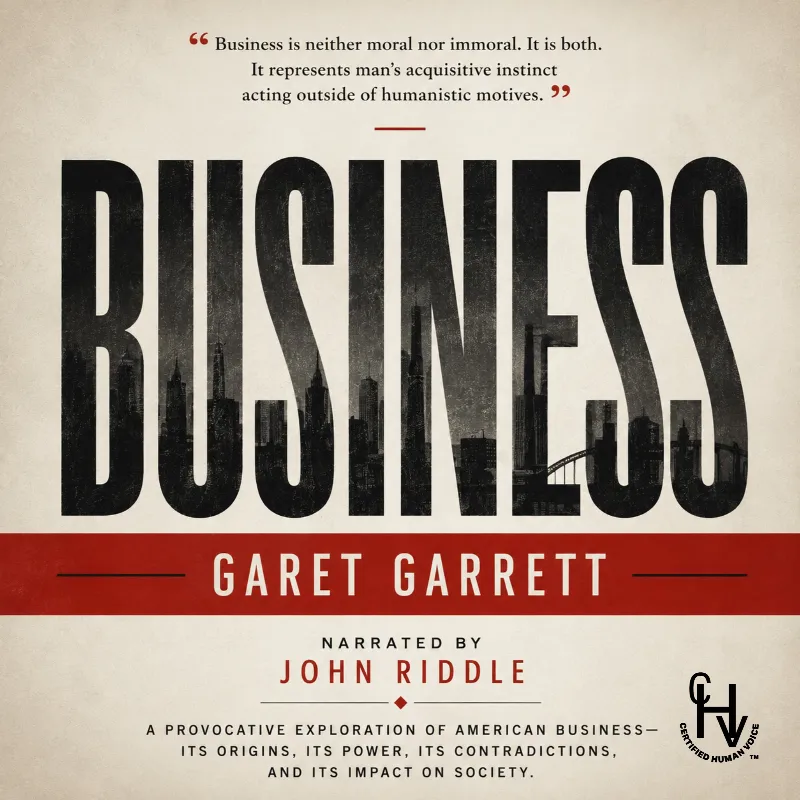
Modern business, says Garet Garrett, comes from three passions: for things, for personal grandeur, and for power. These are weak in the East, strong in Europe and strongest in America.
Hear it read by JOHN RIDDLE: the audiobook is right here
Story guide on this page: summary, characters, discussion questions
Yours to keep: a DRM-free EPUB for any device. Read it here, or on Kindle (with Send to Kindle), Apple Books, Kobo or Google Play Books.
Want both? Buy the audiobook and add the ebook for $0.99.
Free audiobook
Listen to the whole story free
Enter your email and we'll send you a link to the full audiobook of Business. No account needed.
We'll also ask if you'd like new audiobooks by email. Privacy Policy
✓ DRM-free, yours to keep. Download the files after you buy and play them anywhere.
Yours to keepBuy once, it stays in your library
Listen anywhereIn our app on your phone or computer
Bought by mistake, or something wrong with the file? Email apica@academyvoices.com within 14 days for a full refund.
Bought by mistake or something wrong with the audio? Email apica@academyvoices.com within 14 days for a full refund.
About this audiobookAbout this book
Modern business, says Garet Garrett, comes from three passions: for things, for personal grandeur, and for power. These are weak in the East, strong in Europe and strongest in America. He asks what makes American business different in kind, and why a man here can use it almost as a kingdom.
This essay comes from Civilization in the United States, a 1922 collection edited by Harold Stearns. Read by JOHN RIDDLE in fifty-five minutes.
Story guide
Business summary
Spoiler alert: this summary tells the whole story.
Garrett begins by saying that modern business grows from three passions: the love of things, the love of personal grandeur and the love of power. He traces American business back to colonial days, when British laws banned many kinds of colonial manufacturing and trade. Smuggling became a folk custom, and the impatience with legal limits that still marks American business was then a patriotic virtue.
For a long time most Americans lived on farms and bought little. Garrett points to a New Jersey farm whose old cedar rail fence has outlasted a revolution: the farmer once drove a sand road to Trenton a few times a year, and now delivery trucks bring bread, meat, groceries and ready-made clothes every morning. The great change came between 1850 and 1860, when railroads, the telegraph and the California gold rush suddenly freed the country's energy.
Credit, which Garrett calls "phantom capital," let merchants and makers do business with borrowed money. Fierce competition drove profits so low that goods were cheapened and adulterated, until big business arose through mergers and trusts. Large companies restored the quality of goods with brands and trade-marks, and chain stores answered with mass selling. Railroads, chasing long hauls of heavy freight, helped create steel towns, meat towns and flour towns, and gave secret rebates to the biggest shippers.
Business itself, Garrett argues, is neither moral nor immoral. Most of it is run by corporations, in which no one feels personally responsible for what is done. Slowly, he notes, the government has learned to control railroads and the largest companies.
In his final reckoning, Garrett says American business has produced wealth beyond anything the world had known, but also an angry working class, wasted lives, wasted goods and recurring panics. In 1921, business leaders even complained that the country was "over-equipped" and could produce more than it needed. The essay remains a sharp, readable account of how America's economy took shape, and of questions about corporations that are still argued today.
Famous lines
Business is neither moral nor immoral.
Garrett
Nobody is personally responsible.
Garrett, on how corporations work
Ruined by over-plenty!
Garrett, on the business slump of 1921
Main characters
GG
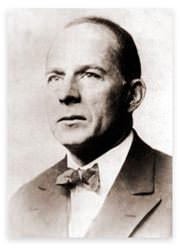
Garet GarrettThe financial journalist who wrote the essay.
JH
John HancockThe signer of the Declaration of Independence, named as a celebrated colonial smuggler.
AT
A. T. StewartThe New York merchant who dared to sell to all buyers at one fixed price.
JL
John LawThe eighteenth-century financier whose Mississippi Bubble Garrett uses as a closing image.
Did you know?
Civilization in the United States gathered essays by thirty writers on American life, from business and politics to sport and the arts. It was edited by Harold Stearns and published in 1922.
Garet Garrett was a New York financial journalist who later wrote for many years for The Saturday Evening Post.
The Standard Oil case Garrett mentions ended in 1911, when the United States Supreme Court ordered the giant oil trust broken up.
Questions to talk about
Garrett says business grows from three passions: things, grandeur and power. Which do you think drives business most today?
What does the story of the New Jersey farm show about how dependent Americans had become on business?
Why does Garrett say that in a corporation "nobody is personally responsible"? Do you agree?
How could a country be "ruined by over-plenty"? What does Garrett find absurd about this?
Which of Garrett's worries about business still seem relevant a hundred years later?
New listeners
Get 25% off your first audiobook
Join our list and we'll email you 25% off, plus new releases from our store. Every one is read by a real person. No account needed.
Details
Length
55 min
Narration
Solo narrator
Format
Unabridged audiobook
Publisher
Academy Voices
Language
English
ISBN
9798182618755
Questions
What is Business about?
Garet Garrett's 1922 essay on how American business grew from colonial smuggling and frontier trade into giant corporations, and what that growth has gained and cost the country.
Who are the main characters in Business?
Garet Garrett, the financial journalist who wrote the essay; John Hancock, the signer of the Declaration of Independence, named as a celebrated colonial smuggler; A. T. Stewart, the New York merchant who dared to sell to all buyers at one fixed price; John Law, the eighteenth-century financier whose Mississippi Bubble Garrett uses as a closing image.
Who narrates the Business audiobook?
This edition of Business by Garet Garrett is narrated by JOHN RIDDLE.
How long is the Business audiobook?
It runs 55 min, unabridged, so you hear the complete text.
Is this audiobook narrated by a real person?
Yes. Every Academy Voices audiobook is Certified Human Voice: performed start to finish by a real narrator.
Where can I listen to Business?
Right here: buy it on Academy Voices and listen in your browser or our app. Hear a free sample on this page first.