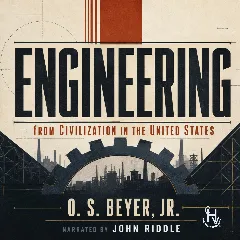
Hear it read by JOHN RIDDLE: the audiobook is right here
Story guide on this page: summary, characters, discussion questions
Yours to keep: a DRM-free EPUB for any device. Read it here, or on Kindle (with Send to Kindle), Apple Books, Kobo or Google Play Books.
Want both? Buy the audiobook and add the ebook for $0.99.
Free audiobook
Listen to the whole story free
Enter your email and we'll send you a link to the full audiobook of Engineering (from Civilization in the United States). No account needed.
We'll also ask if you'd like new audiobooks by email. Privacy Policy
✓ DRM-free, yours to keep. Download the files after you buy and play them anywhere.
Yours to keepBuy once, it stays in your library
Listen anywhereIn our app on your phone or computer
Bought by mistake, or something wrong with the file? Email apica@academyvoices.com within 14 days for a full refund.
Bought by mistake or something wrong with the audio? Email apica@academyvoices.com within 14 days for a full refund.
About this audiobookAbout this book
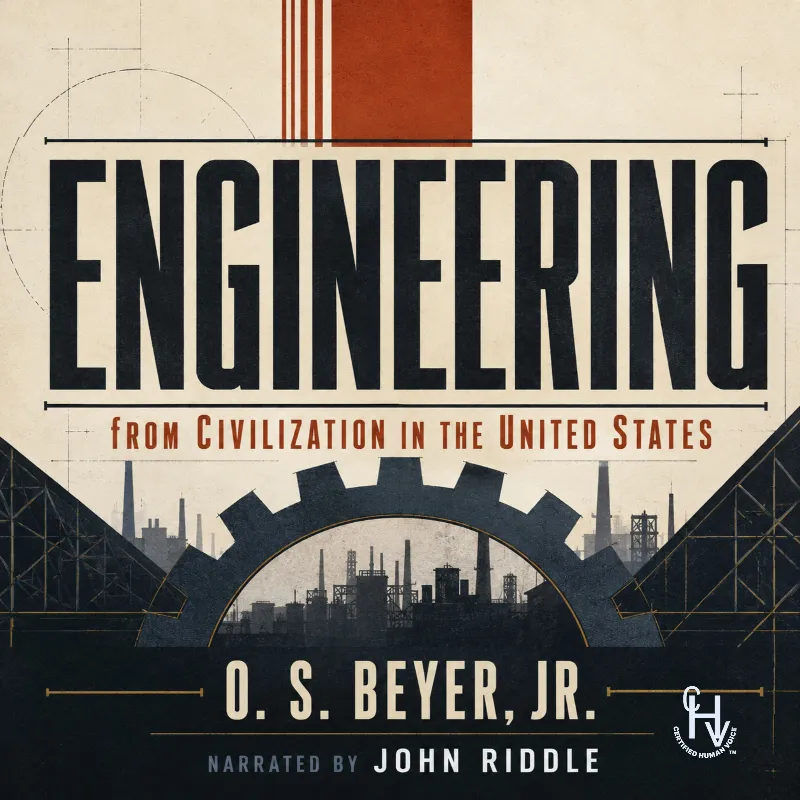
American engineering began soon after the Revolutionary War, when the new country could finally build its own roads, canals and machines. O. S. Beyer, Jr. traces how the engineer grew from a skilled craftsman into a trained professional, and what that new kind of man now means to American industry.
This essay comes from Civilization in the United States, a 1922 collection edited by Harold Stearns in which writers took stock of American life. It is read by JOHN RIDDLE in thirty minutes.
Story guide
Engineering (from Civilization in the United States) summary
Spoiler alert: this summary tells the whole story.
Beyer begins with history. Under British rule the colonies were kept to farming, so American engineering only began after the Revolution, when the new citizens set out to build machines, roads, canals and cities. The first engineers were skilled craftsmen with little formal training. Real engineering schools spread only after the Morrill Act of 1862, and by 1922 they were turning out about 5,000 engineers a year. Civil engineers, who built bridges, canals and dams, came first, but mechanical and electrical engineers now far outnumber them.
At first, engineering meant harnessing the power of nature for human use, and American engineers did that brilliantly. Now, Beyer says, a newer problem has appeared: how industry is managed and controlled. These problems are human and economic, not mechanical. A new wing of the profession wants engineers to manage industry and serve society as a whole, and engineers have widened their own definition of their work to include "the art of organizing and of directing human activities." Yet engineers feel unimportant beside financiers, and their creative drive is often blocked, so they have started to study waste and poor management across whole industries.
Most engineers believe they can stay neutral between capital and labor. Beyer doubts it. A minority has already joined the organized labor movement, saying the engineer is a wage earner like any other worker. The American Federation of Labor has asked for cooperation between labor and "the scientist of industry." Engineers hold the real trade secrets of industry, Beyer argues, and without them modern production would fall into chaos. Owning industry means little without the skill to run it, as attempts in Russia and Italy have shown, so workers and engineers should meet each other halfway.
Beyer is frank about his profession's weaknesses. Engineering schools turn out good technicians but not "far-seeing economic statesmen." Some engineers wrongly think experts should run everything, and some chase vague mystical systems like "time-binding." Others argue for years over steam versus electric railways without seeing that the real question is economic. What engineers need, he says, is a deep study of society's economic and political institutions and the habit of sharp, honest criticism. He sees hope in the new federation of engineering societies, in their national studies of industry, and in a growing friendship with labor, but he ends bluntly: in America today, no such industrial leadership exists.
The essay is a short, clear look at a young profession at a turning point, and its call for engineers to study society as well as machines still echoes in debates about technology today.
Famous lines
As against the old engineer, concerned primarily with design and construction, there is to be recognized the new engineer, concerned mainly with industrial management.
O. S. Beyer Jr.
It has succeeded in turning out good technical practitioners, not far-seeing economic statesmen.
O. S. Beyer Jr., on engineering education
Without their guidance the present highly complicated system of production would quickly tumble into chaos.
O. S. Beyer Jr., on engineers
In America to-day no such leadership exists.
The closing line
Did you know?
Civilization in the United States was a famous 1922 collection of essays on American life, edited by the critic Harold Stearns.
The Morrill Act of 1862, which Beyer credits with putting engineering training on a firm footing, gave federal land to the states to found colleges teaching agriculture and the mechanic arts.
"Time-binding," one of the ideas Beyer mocks, was coined by the engineer Alfred Korzybski in his 1921 book Manhood of Humanity.
Questions to talk about
How does Beyer say the job of an engineer changed between the 1800s and 1922?
Why does he doubt that engineers can stay neutral between business owners and workers?
Beyer says owning industry means little without the skill to run it. What does he mean, and do you agree?
What two things does he say engineers lack? Do engineering students today get them?
He warns against handing "the entire running of things human" to technical experts. How does that warning apply to technology today?
New listeners
Get 25% off your first audiobook
Join our list and we'll email you 25% off, plus new releases from our store. Every one is read by a real person. No account needed.
Details
Length
26 min
Narration
Solo narrator
Format
Unabridged audiobook
Publisher
Academy Voices
Language
English
ISBN
9798182600071
Questions
What is Engineering (from Civilization in the United States) about?
The engineer O. S. Beyer Jr. traces the rise of the American engineer and argues that engineers, though now essential to industry, lack the broad education and critical sense to lead society, and should work with organized labor.
Who narrates the Engineering (from Civilization in the United States) audiobook?
This edition of Engineering (from Civilization in the United States) by O. S. Beyer, Jr. is narrated by JOHN RIDDLE.
How long is the Engineering (from Civilization in the United States) audiobook?
It runs 26 min, unabridged, so you hear the complete text.
Is this audiobook narrated by a real person?
Yes. Every Academy Voices audiobook is Certified Human Voice: performed start to finish by a real narrator.
Where can I listen to Engineering (from Civilization in the United States)?
Right here: buy it on Academy Voices and listen in your browser or our app. Hear a free sample on this page first.