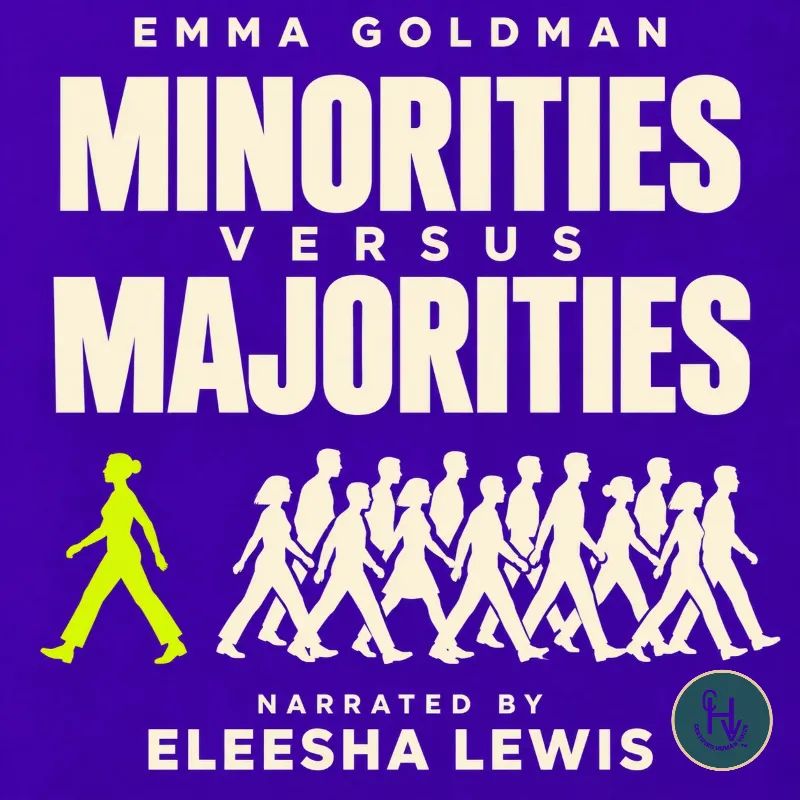
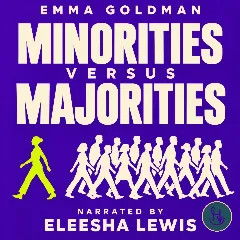
Who moves the world forward—the crowd, or the courageous few? In Minorities Versus Majorities, Emma Goldman delivers a piercing indictment of mob rule and the worship of numbers.
Hear it read by Eleesha Lewis: the audiobook is right here
Story guide on this page: summary, characters, discussion questions
Yours to keep: a DRM-free EPUB for any device. Read it here, or on Kindle (with Send to Kindle), Apple Books, Kobo or Google Play Books.
Want both? Buy the audiobook and add the ebook for $0.99.
Free audiobook
Listen to the whole story free
Enter your email and we'll send you a link to the full audiobook of Minorities Versus Majorities. No account needed.
We'll also ask if you'd like new audiobooks by email. Privacy Policy
✓ DRM-free, yours to keep. Download the files after you buy and play them anywhere.
Yours to keepBuy once, it stays in your library
Listen anywhereIn our app on your phone or computer
Bought by mistake, or something wrong with the file? Email apica@academyvoices.com within 14 days for a full refund.
Bought by mistake or something wrong with the audio? Email apica@academyvoices.com within 14 days for a full refund.
About this audiobookAbout this book
Who moves the world forward—the crowd, or the courageous few? In Minorities Versus Majorities, Emma Goldman delivers a piercing indictment of mob rule and the worship of numbers. With bracing clarity, she shows how the mass—swayed by demagogues, dazzled by spectacle, and addicted to quantity over quality—smothers conscience, originality, and truth.
Goldman ranges across politics, public opinion, education, literature, and art, exposing the tyranny of conformity and the marketplace of vulgar taste. Against this backdrop she champions the minority: the pioneer, educator, artist, scientist, and rebel whose integrity and initiative light every genuine advance in human freedom.
Narrated by Eleesha Lewis with crisp, empathetic power, this landmark essay invites listeners to question easy slogans about democracy and to consider the moral courage it takes to dissent. Provocative, lyrical, and urgent, it speaks to anyone troubled by groupthink and inspired by the solitary voice that dares to say no.
Essential listening for fans of political philosophy, social criticism, radical history, and feminist thought.
Story guide
Minorities Versus Majorities summary
Spoiler alert: this summary tells the whole story.
Goldman opens by naming the spirit of her age in one word: quantity. Workers turn out huge amounts of shoddy goods, politics cares only for numbers of votes, and success is the only god. Even when the corruption of the ruling party is exposed, she says, the majority votes it back in, because the majority cannot reason. She quotes Dr. Stockmann, the hero of Ibsen's play An Enemy of the People, who calls "the compact majority" the most dangerous enemy of truth.
She goes on to show the mass crushing originality everywhere. Daring teachers like Francisco Ferrer are not tolerated, popular writers are idolized while Emerson, Thoreau, Whitman and Ibsen are little read, and American statues are ugly because they suit mass taste. Art patrons judge a painting only by its price. Quoting Wendell Phillips, she says Americans are "a mass of cowards," afraid of each other's opinion, and she blames this for the rise of Theodore Roosevelt, whom she calls a master of mob psychology.
History, Goldman argues, proves her point. Christianity, the Protestant Reformation, the peasant revolts, the French Revolution and the fight against slavery were all begun by brave minorities, while the majority lagged behind or turned cruel once it took over. Lincoln, she says, followed the abolitionists only when abolition had become popular. Even socialism, once a daring idea, has grown tame now that everyone claims it.
She ends by insisting that she feels for the oppressed, but that the mass, as a mass, has never stood for justice. It is the mass that serves as soldiers, police and jailers, and so keeps power in place. Real social and economic well-being, she concludes, will come only through the courage of intelligent minorities.
The essay is a fiery, provocative example of Goldman's thinking and a useful starting point for debates about democracy, conformity and who really drives change.
Famous lines
If I were to give a summary of the tendency of our times, I would say, Quantity.
The opening line
The most unpardonable sin in society is independence of thought.
Goldman
The most dangerous enemies of truth and justice in our midst are the compact majorities, the damned compact majority.
Dr. Stockmann, quoted by Goldman
Main characters
EG
Emma GoldmanThe anarchist writer and speaker who wrote the essay.
S
Dr. StockmannThe hero of Ibsen's An Enemy of the People, whose attack on the "compact majority" Goldman quotes.
WP
Wendell PhillipsThe abolitionist speaker whose words on American cowardice she borrows.
RW
Ralph Waldo EmersonThe writer whose harsh words on "the masses" close her argument.
TR
Theodore RooseveltThe former president she treats as the champion of mob psychology.
Did you know?
Emma Goldman edited the anarchist magazine Mother Earth from 1906 to 1917.
In 1919 the United States government deported Goldman to Russia, along with more than two hundred other radicals.
Dr. Stockmann comes from Henrik Ibsen's 1882 play An Enemy of the People, in which a doctor is turned on by his whole town for telling the truth about its polluted water.
Questions to talk about
What does Goldman mean when she says the tendency of her time is "Quantity"? Does that describe our time too?
Do you agree that all real progress comes from minorities? Can you think of examples for and against?
Goldman says the mass "loves the whip." Is that fair to ordinary people? Why or why not?
How does her view of Lincoln and the abolitionists change the usual story of the end of slavery?
If Goldman is right about majorities, what does that mean for democracy?
New listeners
Get 25% off your first audiobook
Join our list and we'll email you 25% off, plus new releases from our store. Every one is read by a real person. No account needed.
Details
Length
20 min
Narration
Solo narrator
Format
Unabridged audiobook
Publisher
Anthony Pica Productions, LLC
Language
English
Questions
What is Minorities Versus Majorities about?
Anarchist Emma Goldman's essay arguing that the mass of people resists every new idea, and that all real progress has come from bold, independent minorities.
Who are the main characters in Minorities Versus Majorities?
Emma Goldman, the anarchist writer and speaker who wrote the essay; Dr. Stockmann, the hero of Ibsen's An Enemy of the People, whose attack on the "compact majority" Goldman quotes; Wendell Phillips, the abolitionist speaker whose words on American cowardice she borrows; Ralph Waldo Emerson, the writer whose harsh words on "the masses" close her argument; Theodore Roosevelt, the former president she treats as the champion of mob psychology.
Who narrates the Minorities Versus Majorities audiobook?
This edition of Minorities Versus Majorities by Emma Goldman is narrated by Eleesha Lewis.
How long is the Minorities Versus Majorities audiobook?
It runs 20 min, unabridged, so you hear the complete text.
Is this audiobook narrated by a real person?
Yes. Every Academy Voices audiobook is Certified Human Voice: performed start to finish by a real narrator.
Where can I listen to Minorities Versus Majorities?
Right here: buy it on Academy Voices and listen in your browser or our app. Hear a free sample on this page first.