The Small Town (from Civilization in the United States)
By Louis Raymond Reid
Narrated by Ryan Durham
 Audiobooks
Showing results for
Nothing matches yet. Try one word of the title, or the author's last name.
See all results for “” →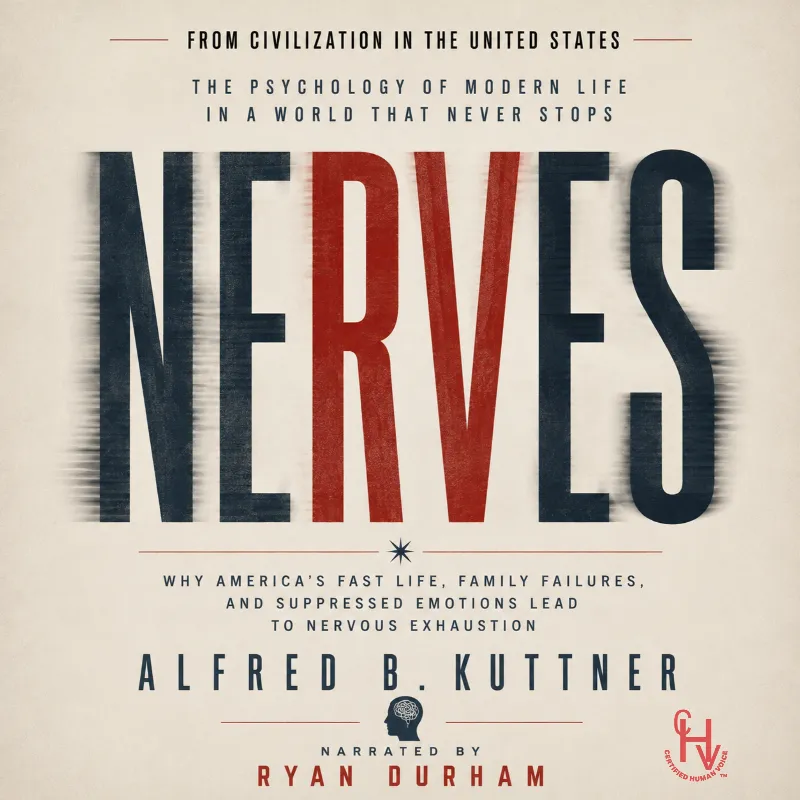

Hi, I’m Ryan Durham — husband, father, pastor and a passionate audiobook narrator!Hear more from Ryan → Tip Ryan for this narration →
by Alfred B. Kuttner · read by Ryan Durham · 46 min
Read more ↓Yours to keep: a DRM-free EPUB for any device. Read it here, or on Kindle (with Send to Kindle), Apple Books, Kobo or Google Play Books. Want both? Buy the audiobook and add the ebook for $0.99.
Enter your email and we'll send you a link to the full audiobook of Nerves (from Civilization in the United States). No account needed.
We'll also ask if you'd like new audiobooks by email. Privacy Policy✓ DRM-free, yours to keep. Download the files after you buy and play them anywhere.
Bought by mistake, or something wrong with the file? Email apica@academyvoices.com within 14 days for a full refund.
Bought by mistake or something wrong with the audio? Email apica@academyvoices.com within 14 days for a full refund.
Young as America is, she is old enough to remember when nobody had nerves. Alfred B. Kuttner traces how nerves came into American life. The early settlers, he notes, died of hunger, cold and sudden illness, and nervous trouble was not part of their world. He asks what changed. This essay comes from Civilization in the United States, a 1922 collection edited by Harold Stearns. Read by Ryan Durham in forty-six minutes.
Spoiler alert: this summary tells the whole story.
Alfred B. Kuttner begins with a joke: America is young, yet old enough to remember a time before nerves. Early settlers, he argues, had plenty of nervous troubles but hid them in new religious sects or simply moved further west, so they were never named. The witch hunts of the 1600s, he suggests, were the one great outbreak of hysteria.
The first nervous illness to be named on a grand scale was neurasthenia, popularized from the late 1860s by Dr. George M. Beard, who called it "the American disease" and blamed steam power, newspapers, the telegraph, science and even the beauty of American women. Kuttner credits Beard with seeing that nervous illness is linked to culture, but mocks how the label swallowed up real diseases and opened the way for quack nerve tonics, sanitariums and the famous rest cure of S. Weir Mitchell.
He then follows the rise of the two great European theories of nervous illness, Pierre Janet's and Sigmund Freud's. Freud's 1909 lectures at Clark University made him famous in America, but Kuttner complains that his ideas were either wildly embraced, rejected outright, or watered down, and that hundreds of untrained people set up as psychoanalysts. He insists Freud has been "oversexualized" by friends and enemies alike.
In the last part Kuttner turns psychoanalysis on American society itself. He points to an exaggerated worship of mothers, a compulsive need to think and feel alike, and the power of fanatical reformers who campaign against alcohol, tobacco and amusements. He quotes the philosopher George Santayana, who called America "the land of compulsions," and ends by describing how both immigrants and old-stock Americans are caught in a tense, anxious conformity.
The essay is a sharp, witty and opinionated snapshot of how educated Americans of the early 1920s were starting to use the new ideas of psychology to examine their own country.
Young as America is, she is nevertheless old enough to have known the time when there were no such things as nerves.
Though it calls itself the land of freedom, it is really the land of compulsions, and one of the greatest compulsions is that we must think and feel alike.
We are indeed ultra-conformists, and our fear of other-mindedness amounts almost to a phobia.
Join our list and we'll email you 25% off, plus new releases from our store. Every one is read by a real person. No account needed.
A 1922 essay tracing how Americans have dealt with "nerves," from the craze for neurasthenia to the arrival of Freud, and arguing that much of American life is shaped by anxious conformity.
Alfred B. Kuttner, the author, an early American writer on psychoanalysis; George M. Beard, the doctor who made neurasthenia famous as "the American disease."; S. Weir Mitchell, the physician known for the rest cure for nervous patients; Sigmund Freud, the founder of psychoanalysis, whose American reception the essay traces; Pierre Janet, a French psychologist whose rival theory of hysteria lost ground to Freud's; George Santayana, the philosopher Kuttner quotes on America as a land of compulsions.
This edition of Nerves (from Civilization in the United States) by Alfred B. Kuttner is narrated by Ryan Durham.
It runs 46 min, unabridged, so you hear the complete text.
Yes. Every Academy Voices audiobook is Certified Human Voice: performed start to finish by a real narrator.
Right here: buy it on Academy Voices and listen in your browser or our app. Hear a free sample on this page first.
By Louis Raymond Reid
Narrated by Ryan Durham
By J. E. Spingarn
Narrated by Ryan Durham
By Van Wyck Brooks
Narrated by Eleesha Lewis
By Henry L. Stuart
Narrated by JOHN RIDDLE