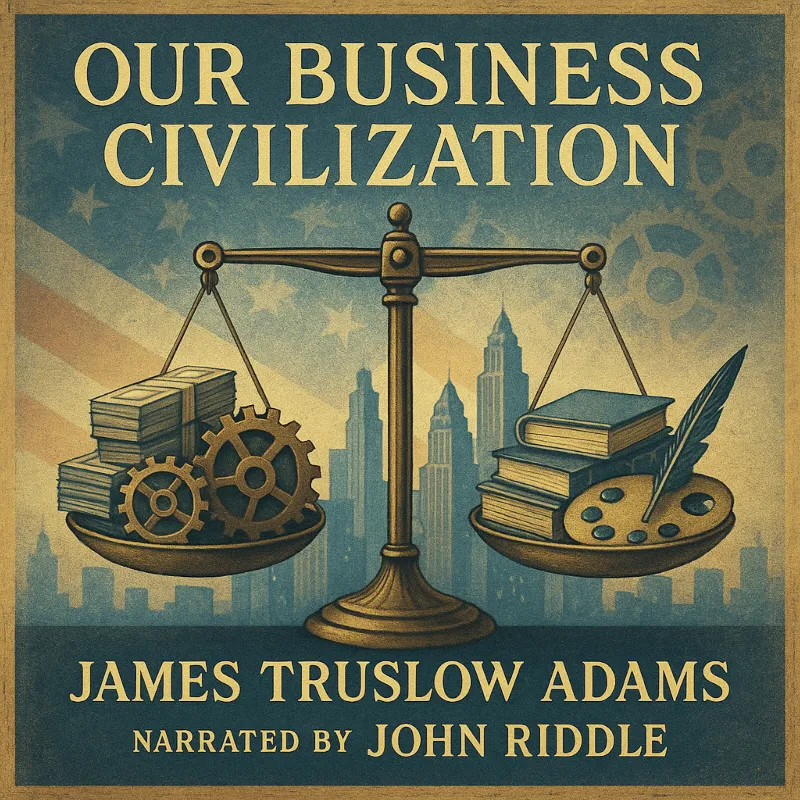
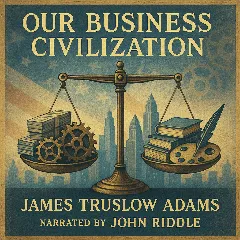
James Truslow Adams asks what happens to a country when business becomes its main idea. In these essays he looks at money, success, ethics, the professions and the pressure to keep up, and compares the American way with the English one.
Hear it read by JOHN RIDDLE: the audiobook is right here
Story guide on this page: summary, characters, discussion questions
Yours to keep: a DRM-free EPUB for any device. Read it here, or on Kindle (with Send to Kindle), Apple Books, Kobo or Google Play Books.
Want both? Buy the audiobook and add the ebook for $0.99.
✓ DRM-free, yours to keep. Download the files after you buy and play them anywhere.
Yours to keepBuy once, it stays in your library
Listen anywhereIn our app on your phone or computer
Bought by mistake, or something wrong with the file? Email apica@academyvoices.com within 14 days for a full refund.
Bought by mistake or something wrong with the audio? Email apica@academyvoices.com within 14 days for a full refund.
About this audiobookAbout this book
James Truslow Adams asks what happens to a country when business becomes its main idea. In these essays he looks at money, success, ethics, the professions and the pressure to keep up, and compares the American way with the English one.
Published in 1929, the collection argues that business brought comfort but weakened the life of the mind. Read by JOHN RIDDLE. Almost ten hours.
For readers interested in American history and ideas.
Story guide
Our Business Civilization summary
Spoiler alert: this summary tells the whole story.
Adams opens with a warning in his preface: these essays look only at the "more sinister" side of American life, the way a doctor examines a patient's infection without praising his good character. The title essay argues that America is the first great nation where business people are the only dominant class. In Europe, an old aristocracy, the church, the army and the universities offered other ideals than making money. In America, he says, those other classes are being absorbed into business, and he asks whether a great civilization can rest on the values of the counting-house.
Several essays examine the costs of the boom. "The Cost of Prosperity" questions the boast that Americans enjoy the highest standard of living in history, pointing to endless spending, installment buying, pressure to keep up with neighbors and the lack of rest or security. "Our Dissolving Ethics" refuses to blame the rebellious young people of the Jazz Age, arguing that their elders taught them, by example, to chase wealth and luxury. "Mass Production and Intellectual Production" shows professors, writers and other thinkers being squeezed between rich owners and well-paid factory workers.
Adams also looks at law and politics. "Jefferson and Hamilton Today" contrasts Jefferson's faith in the people with Hamilton's faith in a strong government run by the wealthy, and says modern America preaches the first while practicing the second. "Our Lawless Heritage" argues that Americans have disobeyed laws they disliked since colonial days, and that Prohibition has made this far worse. "Hoover and Law Observance" urges the new president to lead a moral renewal, warning that disorder can end in dictatorship.
The later essays turn to culture and daily life. Adams criticizes schools and colleges that swap literature and history for business courses, and the "mucker pose" of educated people who pretend to be crude to fit in. He complains that Americans fire questions instead of truly conversing, rejects the excuse that America is too young a country for culture, and compares the standardized American way of life with the freedom and variety he finds in London. The book ends with "The Art of Living," a call for Americans to stop following the crowd and, in Emerson's words, to "Be yourself," so that life can be lived as an art and not only as a business.
Published in 1929, the year of the great stock market crash, the book reads today as a striking warning. Its questions about consumerism, education and what a society truly values still feel current.
Famous lines
In a word, can a great civilization be built up or maintained upon the philosophy of the counting-house and the sole basic idea of a profit?
James Truslow Adams
Lawlessness has been and is one of the most distinctive American traits.
James Truslow Adams
Our critics have often assured us that the dollar sign is the symbol of America.
James Truslow Adams
It is not impossible that the world of men may eventually be infinitely poorer because of our colossal and unthinking prosperity.
James Truslow Adams
Main characters
JT
James Truslow AdamsThe author, a historian and former businessman who writes as a friendly but frank critic of his own country.
TJ
Thomas JeffersonThe founder whose faith in ordinary people Adams compares with modern American practice.
AH
Alexander HamiltonThe founder whose vision of government by and for the wealthy Adams sees winning out.
HH
Herbert HooverThe newly elected president whom Adams urges to restore respect for law.
Did you know?
Adams won the Pulitzer Prize for History for The Founding of New England.
Two years later, in The Epic of America (1931), Adams popularized the phrase "the American Dream."
Adams says in his preface that the essays first appeared in magazines including Harper's, the Atlantic Monthly and the Forum.
Questions to talk about
Adams says America is the first civilization ruled only by business people. Do you agree? What other groups shape a country's values?
Which of Adams's warnings about prosperity and spending seem most true today?
Adams blames older Americans, not young people, for the loose morals of the 1920s. Is that fair?
What is the "mucker pose," and do you see anything like it now?
The book came out in 1929, the year the stock market crashed. How might readers have felt about it a year later?
Chapters
Our Business Civilization chapters
ChapterStarts at
Chapter 10:24
Chapter 254:26
Chapter 31:52:12
Chapter 42:29:52
Chapter 53:02:28
Chapter 63:41:00
Chapter 74:33:22
Chapter 85:39:14
Chapter 96:09:55
Chapter 107:01:33
Show all 13 chapters
Chapter 117:40:43
Chapter 128:18:20
Chapter 139:16:56
New listeners
Get 25% off your first audiobook
Join our list and we'll email you 25% off, plus new releases from our store. Every one is read by a real person. No account needed.
Details
Length
9 hr 58 min
Narration
Solo narrator
Format
Unabridged audiobook
Publisher
Academy Voices
Language
English
ISBN
9798347397563
Questions
What is Our Business Civilization about?
In thirteen sharp essays written at the height of the 1920s boom, historian James Truslow Adams asks whether a nation built on business, profit and mass production can also build a rich, humane and law-abiding civilization.
Who are the main characters in Our Business Civilization?
James Truslow Adams, the author, a historian and former businessman who writes as a friendly but frank critic of his own country; Thomas Jefferson, the founder whose faith in ordinary people Adams compares with modern American practice; Alexander Hamilton, the founder whose vision of government by and for the wealthy Adams sees winning out; Herbert Hoover, the newly elected president whom Adams urges to restore respect for law.
Who narrates the Our Business Civilization audiobook?
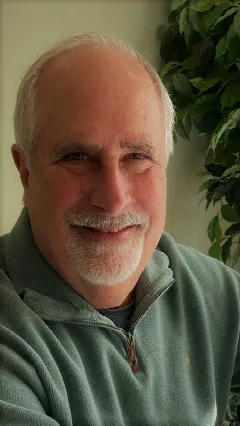
This edition of Our Business Civilization by James Truslow Adams is narrated by JOHN RIDDLE.
How long is the Our Business Civilization audiobook?
It runs 9 hr 58 min, unabridged, so you hear the complete text.
Is this audiobook narrated by a real person?
Yes. Every Academy Voices audiobook is Certified Human Voice: performed start to finish by a real narrator.
Where can I listen to Our Business Civilization?
Right here: buy it on Academy Voices and listen in your browser or our app. Hear a free sample on this page first.