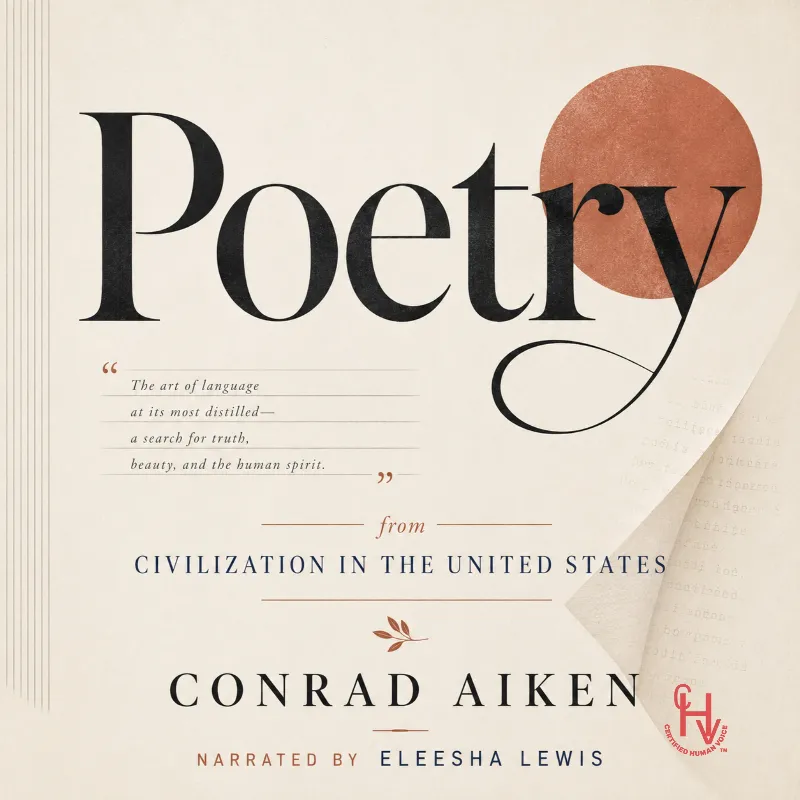
Hear it read by Eleesha Lewis: the audiobook is right here
Story guide on this page: summary, characters, discussion questions
Yours to keep: a DRM-free EPUB for any device. Read it here, or on Kindle (with Send to Kindle), Apple Books, Kobo or Google Play Books.
Want both? Buy the audiobook and add the ebook for $0.99.
Free audiobook
Listen to the whole story free
Enter your email and we'll send you a link to the full audiobook of Poetry (from Civilization in the United States). No account needed.
We'll also ask if you'd like new audiobooks by email. Privacy Policy
✓ DRM-free, yours to keep. Download the files after you buy and play them anywhere.
Yours to keepBuy once, it stays in your library
Listen anywhereIn our app on your phone or computer
Bought by mistake, or something wrong with the file? Email apica@academyvoices.com within 14 days for a full refund.
Bought by mistake or something wrong with the audio? Email apica@academyvoices.com within 14 days for a full refund.
About this audiobookAbout this book
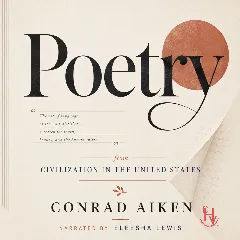
There are many ways to look at American poetry. Some critics say it leans too much on drama and sensation. Others trace it back to Whitman and his open welcome to the new world. Conrad Aiken surveys these views of the poetry of his own time and says what each leaves out.
This essay comes from Civilization in the United States, a 1922 collection edited by Harold Stearns. Read by Eleesha Lewis in thirty-three minutes.
Story guide
Poetry (from Civilization in the United States) summary
Spoiler alert: this summary tells the whole story.
Aiken begins by laying out how other critics see American poetry. The English critic John Middleton Murry finds it too fond of story and sensation. Louis Untermeyer praises poets who follow Walt Whitman and embrace modern American life. Amy Lowell values a pure focus on beauty. Conservatives prefer gentle, traditional verse. Aiken says each view has some truth, but all of them simplify. America has no single literary heart the way England and France do. It is "many in one," and critics are wrong to expect New England poets to write only of birches or Chicago poets only of stockyards.
What is certain, he says, is that American poetry is in a lively "renaissance" of energy and anarchy that burst into full chorus in 1915. Its roots are not mainly in Whitman, or even in Poe or Emily Dickinson, whom he ranks among the best poets in the language. They lie in Europe: in Browning, the French Symbolists and others. That is no disgrace, he argues, because American poets transform what they borrow. Their lack of classical training frees them to experiment, though it can also leave their taste rough.
Aiken compares the moment to the Elizabethan age, which began in energy and extravagance before it refined itself. Then he sorts the leading poets. Edwin Arlington Robinson, Robert Frost and Edgar Lee Masters bring a strong sense of reality; Masters is harsh and endless, Frost gentle, Robinson dim and mysterious. John Gould Fletcher, H. D., Maxwell Bodenheim and Amy Lowell are "colourists," brilliant with color but cold to human feeling. Ezra Pound links them to the psychological poets T. S. Eliot, Alfred Kreymborg and Wallace Stevens. Carl Sandburg brings social conscience, Vachel Lindsay wild rhythm, and Sara Teasdale grace.
The whole scene, Aiken says, is close to anarchy, but even its ugliest experiments have widened what poetry can do, and many rebels are now returning to rhyme and meter. What the poets lack is "art." Poetry must be serious, carefully made and "packed," not mere confession or lecturing. He hopes for a fusion of all their strengths and concludes that American poetry is healthy, that the future of English poetry lies as much in America as in England, and that its faults are those of a young culture.
Written by a poet who knew many of these writers, the essay is a valuable snapshot of modern American poetry just as it was being born, written before Eliot's The Waste Land appeared in late 1922.
Famous lines
Despite our national motto, American civilization is not so much one in many as many in one.
Conrad Aiken
It must be beautifully elaborate rather than elaborately beautiful.
Conrad Aiken, on what poetry must be
For to go all the way is to arrive exhausted; to go half way is to arrive with vigour.
Conrad Aiken
Main characters
CA
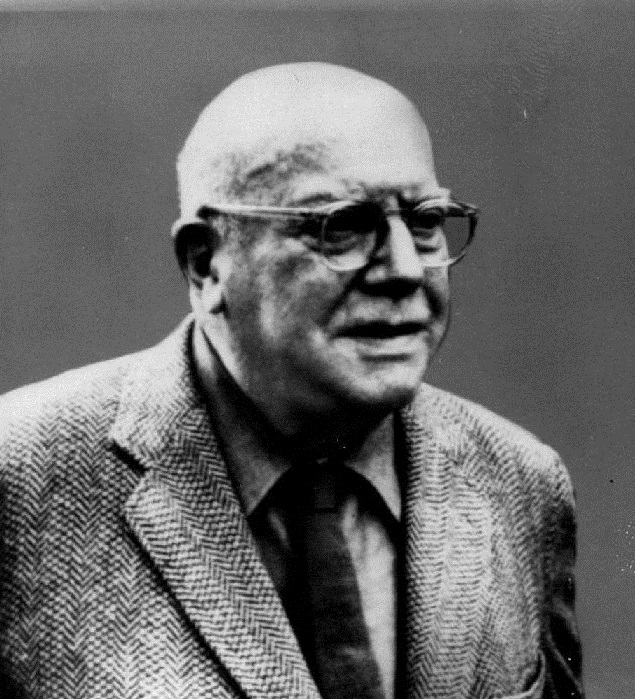
Conrad AikenThe author, an American poet and critic.
RF
Robert FrostA New England poet Aiken praises as gentle and tender in his realism.
EA
Edwin Arlington RobinsonA poet of dim, mysterious portraits whose work Aiken sees growing more moral.
EL
Edgar Lee MastersThe author of Spoon River Anthology, whom Aiken finds powerful but bitter and overflowing.
AL
Amy LowellA poet and critic Aiken calls brilliant and versatile but emotionally cold.
TS
T. S. EliotA poet Aiken admires for technical skill and sharp dramatic phrasing, though narrow in range.
Did you know?
Conrad Aiken won the Pulitzer Prize for Poetry in 1930 for his Selected Poems.
Aiken and T. S. Eliot became friends as students at Harvard, years before Eliot became famous.
Poetry: A Magazine of Verse, which Aiken mentions, was founded in Chicago in 1912 by Harriet Monroe, the "Miss Monroe" of the essay.
Questions to talk about
Why does Aiken say critics are wrong to look for birches in New England poems and stockyards in Chicago poems?
He argues the new poetry owes more to Europe than to Whitman. Why does he think borrowing is not a disgrace?
What does he mean when he says poetry must be "beautifully elaborate rather than elaborately beautiful"?
Which of the poets he describes have lasted best? Was his judgment of them right?
Aiken compares his time to the Elizabethan age. Is that a fair comparison? What does he hope it means?
New listeners
Get 25% off your first audiobook
Join our list and we'll email you 25% off, plus new releases from our store. Every one is read by a real person. No account needed.
Details
Length
33 min
Narration
Solo narrator
Format
Unabridged audiobook
Publisher
Academy Voices
Language
English
ISBN
9798182623865
Questions
What is Poetry (from Civilization in the United States) about?
The poet Conrad Aiken surveys the burst of new American poetry around 1914 to 1921, sorting poets like Frost, Robinson, Masters, Lowell, Pound and Eliot into groups and urging them toward more art and discipline.
Who are the main characters in Poetry (from Civilization in the United States)?
Conrad Aiken, the author, an American poet and critic; Robert Frost, a New England poet Aiken praises as gentle and tender in his realism; Edwin Arlington Robinson, a poet of dim, mysterious portraits whose work Aiken sees growing more moral; Edgar Lee Masters, the author of Spoon River Anthology, whom Aiken finds powerful but bitter and overflowing; Amy Lowell, a poet and critic Aiken calls brilliant and versatile but emotionally cold; T. S. Eliot, a poet Aiken admires for technical skill and sharp dramatic phrasing, though narrow in range.
Who narrates the Poetry (from Civilization in the United States) audiobook?
This edition of Poetry (from Civilization in the United States) by Conrad Aiken is narrated by Eleesha Lewis.
How long is the Poetry (from Civilization in the United States) audiobook?
It runs 33 min, unabridged, so you hear the complete text.
Is this audiobook narrated by a real person?
Yes. Every Academy Voices audiobook is Certified Human Voice: performed start to finish by a real narrator.
Where can I listen to Poetry (from Civilization in the United States)?
Right here: buy it on Academy Voices and listen in your browser or our app. Hear a free sample on this page first.