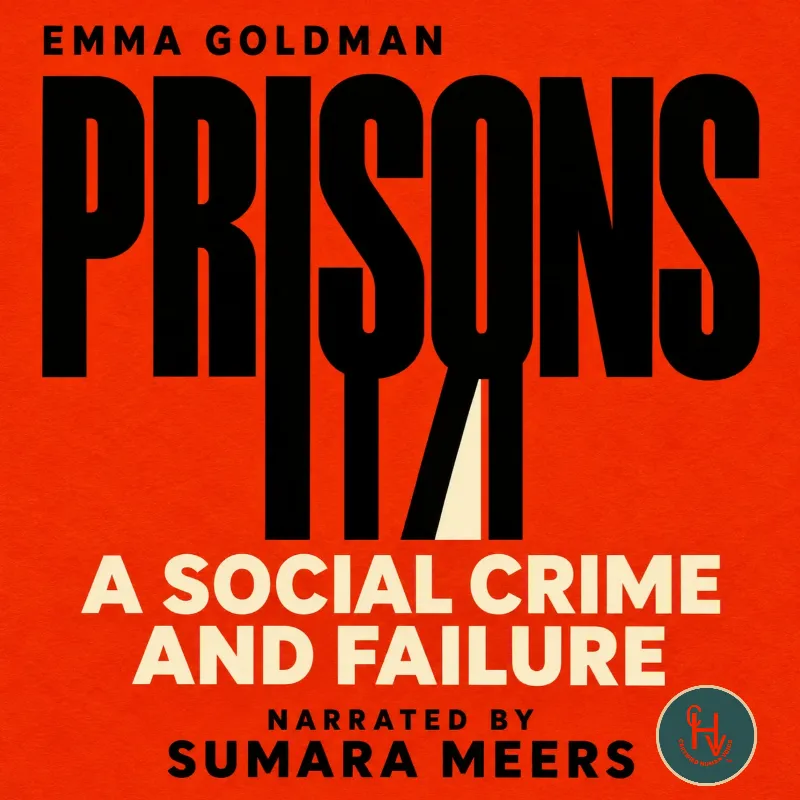
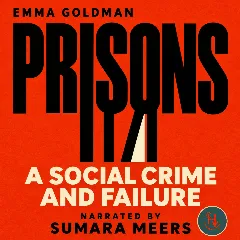
Emma Goldman’s most uncompromising attack on the cage we call “corrections.” In this galvanizing essay, she argues prisons are a social crime and a proven failure: they brutalize, deform, and return people to society more desperate than before.
Hear it read by Sumara Meers: the audiobook is right here
Story guide on this page: summary, characters, discussion questions
Yours to keep: a DRM-free EPUB for any device. Read it here, or on Kindle (with Send to Kindle), Apple Books, Kobo or Google Play Books.
Want both? Buy the audiobook and add the ebook for $0.99.
Free audiobook
Listen to the whole story free
Enter your email and we'll send you a link to the full audiobook of Prisons: A Social Crime and Failure. No account needed.
We'll also ask if you'd like new audiobooks by email. Privacy Policy
✓ DRM-free, yours to keep. Download the files after you buy and play them anywhere.
Yours to keepBuy once, it stays in your library
Listen anywhereIn our app on your phone or computer
Bought by mistake, or something wrong with the file? Email apica@academyvoices.com within 14 days for a full refund.
Bought by mistake or something wrong with the audio? Email apica@academyvoices.com within 14 days for a full refund.
About this audiobookAbout this book
Emma Goldman’s most uncompromising attack on the cage we call “corrections.” In this galvanizing essay, she argues prisons are a social crime and a proven failure: they brutalize, deform, and return people to society more desperate than before. Drawing vivid contrasts—from Dostoyevsky’s hell on earth to Oscar Wilde’s Ballad of Reading Gaol—Goldman dissects the roots of crime in poverty, exploitation, and state power. With insights from Havelock Ellis and others, she distinguishes political, passional, insane, and occasional crimes, showing how punishment, terror, and repression manufacture the very offenses they claim to prevent. Goldman exposes the daily reality behind walls: torture masquerading as “reform,” the soul-killing monotony of confinement, and a convict-labor system that enriches contractors while teaching no trade and starving families. Her remedy is radical and humane: awaken social conscience, end revenge-based justice, demand paid, meaningful work for prisoners, welcome people back with real opportunity, and unite labor with the incarcerated against the system that grinds them both. Narrated with clarity and urgency by Sumara Meers, this audiobook restores the shock, moral force, and contemporary relevance of Goldman’s challenge to the prison-as-solution. Essential listening for readers of prison abolition, criminology, labor history, and anyone questioning why, after so much cost and cruelty, crime only grows.
Story guide
Prisons: A Social Crime and Failure summary
Spoiler alert: this summary tells the whole story.
Goldman opens with a story she says Dostoyevsky wrote on his prison cell wall: the devil shows a priest the foundry, the farm, the workers' hovels and finally a filthy dungeon, and asks why he threatens people with a hell after death when they already live in one. Goldman says the same is true of American prisons. The country spends enormous sums on them, yet crime keeps rising, so they cannot be called a protection.
She looks at the causes of crime, using the scholar Havelock Ellis's four types: political, passionate, insane and occasional criminals. Political criminals, like John Brown, may be the heroes of a later age. The great mass are occasional criminals, driven by poverty, unemployment and slum life. She quotes prisoners who point out that bankers and ministers who rob millions are honored while a man who steals eggs is jailed, and argues that most crimes trace back to economic injustice. Every society, she quotes, has the criminals it deserves.
Goldman then attacks the methods used against crime: revenge, punishment, deterrence by terror and so-called reform. She describes police brutality and the torture still used in prisons, from clubs and straitjackets to solitary confinement and starvation. Prisoners come out broken and soon return. She tells of a woman jailed on Blackwell's Island thirty-eight times.
Until society itself is rebuilt, she proposes practical steps: wake up the public conscience, stop treating ex-prisoners as outcasts, give prisoners real paid work that teaches useful trades, end the corrupt leasing of convict labor to private companies, and abolish long fixed sentences that leave no hope. She closes with lines from Oscar Wilde's Ballad of Reading Gaol. More than a century later, the essay is still quoted in debates about prison reform.
Famous lines
Prison, a social protection? What monstrous mind ever conceived such an idea?
Emma Goldman
Thus we learn that in America there are four and a half times as many crimes to every million population today as there were twenty years ago.
Emma Goldman
The hope of liberty and of opportunity is the only incentive to life, especially the prisoner's life.
Emma Goldman
Main characters
EG
Emma GoldmanThe author, an anarchist who had herself served time in prison.
HE
Havelock EllisThe British writer on crime whose four types of criminal Goldman uses.
FD
Fyodor DostoyevskyThe Russian novelist whose prison parable of the priest and the devil opens the essay.
OW
Oscar WildeThe Irish writer whose Ballad of Reading Gaol she quotes.
Did you know?
Goldman knew prison from the inside. In 1893 she was sentenced to a year on Blackwell's Island in New York for a speech to unemployed workers.
Her close friend Alexander Berkman spent fourteen years in the Pennsylvania penitentiary near Pittsburgh after trying to kill the businessman Henry Clay Frick in 1892.
The closing lines come from Oscar Wilde's poem The Ballad of Reading Gaol, written after his own release from prison.
Questions to talk about
Why does Goldman open with the story of the priest and the devil? What does it say about prison?
What are Havelock Ellis's four types of criminal, and which type does Goldman say fills most prisons?
How does Goldman connect crime to poverty and work? Is her argument convincing?
Why does she think organized labor is wrong to oppose prison work?
Which of her proposals have been adopted since 1910, and which are still debated?
New listeners
Get 25% off your first audiobook
Join our list and we'll email you 25% off, plus new releases from our store. Every one is read by a real person. No account needed.
Details
Length
35 min
Narration
Solo narrator
Format
Unabridged audiobook
Publisher
Anthony Pica Productions, LLC
Language
English
Questions
What is Prisons: A Social Crime and Failure about?
Emma Goldman argues that prisons do not protect society or reform anyone, but instead breed more crime by punishing people for problems that poverty and injustice create.
Who are the main characters in Prisons: A Social Crime and Failure?
Emma Goldman, the author, an anarchist who had herself served time in prison; Havelock Ellis, the British writer on crime whose four types of criminal Goldman uses; Fyodor Dostoyevsky, the Russian novelist whose prison parable of the priest and the devil opens the essay; Oscar Wilde, the Irish writer whose Ballad of Reading Gaol she quotes.
Who narrates the Prisons: A Social Crime and Failure audiobook?
This edition of Prisons: A Social Crime and Failure by Emma Goldman is narrated by Sumara Meers.
How long is the Prisons: A Social Crime and Failure audiobook?
It runs 35 min, unabridged, so you hear the complete text.
Is this audiobook narrated by a real person?
Yes. Every Academy Voices audiobook is Certified Human Voice: performed start to finish by a real narrator.
Where can I listen to Prisons: A Social Crime and Failure?
Right here: buy it on Academy Voices and listen in your browser or our app. Hear a free sample on this page first.