Hear it read by Jim Foster: the audiobook is right here
Story guide on this page: summary, characters, discussion questions
Yours to keep: a DRM-free EPUB for any device. Read it here, or on Kindle (with Send to Kindle), Apple Books, Kobo or Google Play Books.
Want both? Buy the audiobook and add the ebook for $0.99.
✓ DRM-free, yours to keep. Download the files after you buy and play them anywhere.
Yours to keepBuy once, it stays in your library
Listen anywhereIn our app on your phone or computer
Bought by mistake, or something wrong with the file? Email apica@academyvoices.com within 14 days for a full refund.
Bought by mistake or something wrong with the audio? Email apica@academyvoices.com within 14 days for a full refund.
About this audiobookAbout this book
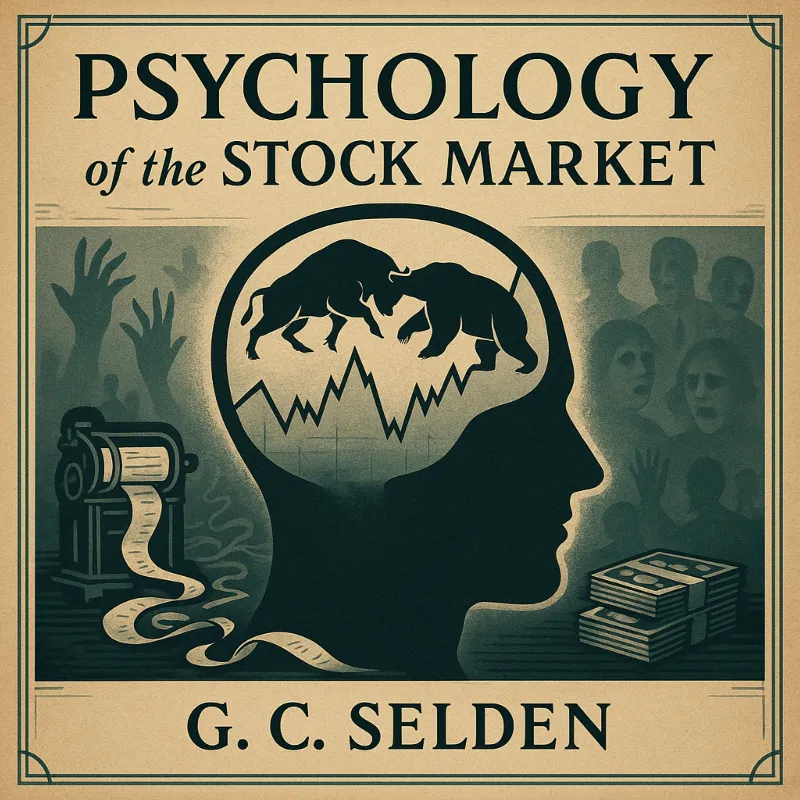
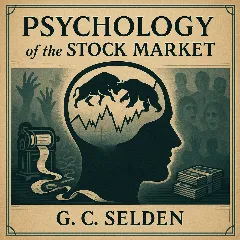
G. C. Selden's central idea is that stock prices depend a great deal on the state of mind of the investing public, not just on business facts. He writes about fear, greed, panic and overconfidence, how the public behaves in booms and crashes, and how to stay cool when others are not.
Published in 1912, it is among the earliest books on the psychology of investing. Read by Jim Foster, just under two hours.
For investors and anyone curious why markets move the way they do.
Story guide
Psychology of the Stock Market summary
Spoiler alert: this summary tells the whole story.
G. C. Selden, a former Columbia University fellow and writer for The Magazine of Wall Street, starts from one idea: the small ups and downs of the market reflect the state of the public mind, while only the long swings follow real business conditions. He opens with a conversation between professional traders who talk themselves around in circles, each guessing what the others will do, to show how much of trading is psychology.
He traces the typical speculative cycle. Prices creep up while the public ignores them, then rise faster as more people climb aboard, until crowds rush in near the top and the market turns. He explains "inverted reasoning," when traders sell on good news because they assume it has already been priced in or was put out to trick them. A chapter on "They" looks at the popular belief that a few big interests, like the Morgan and Standard Oil groups, secretly steer every move. Selden says the great financiers matter, but they cannot simply push prices wherever they like.
Later chapters cover discounting, or confusing the present with the future, and the habit of judging the whole market by one's own position. He explains why panics fall further than conditions justify and why booms run too high, and how rising prices can make people feel richer than they really are and spend accordingly. He compares "impulsive" traders, who buy as prices climb, with "phlegmatic" ones, who place orders on a scale to buy on the way down.
In the final chapter he turns to the individual trader. He warns against stubbornness, against "getting a notion" based on a single fact, and against letting hopes and fears cloud judgment. Sometimes, he suggests, the best cure is a day in the country with the market forgotten.
Written more than a century ago, the book is still read as an early classic of what is now called behavioral finance, and its warnings about crowd psychology sound strikingly modern.
Famous lines
Both the panic and the boom are eminently psychological phenomena.
Selden
Unconsciously to himself, he permits his judgment to be swayed by his hopes.
Selden, on the trader
His fears increase in geometrical proportion to the size of his line of stocks.
Selden
Main characters
GC
G. C. SeldenThe author, a financial writer and statistician on the staff of The Magazine of Wall Street.
T
"They"The mysterious big interests that traders blame for every market move.
IP
The impulsive and the phlegmatic traderSelden's two basic types of market minds, one quick to act and one patient.
Did you know?
The book was published by the company behind The Magazine of Wall Street, where Selden worked as a writer.
Selden refers often to the Panic of 1907, a severe financial crisis that helped lead to the creation of the Federal Reserve in 1913.
Today the study of how emotions and mental habits affect investors is called behavioral finance, and this book is often cited as an early example.
Questions to talk about
Selden says small price moves reflect the public mind while big moves reflect real conditions. Can you think of a recent example of each?
What is "inverted reasoning," and why might good news make a stock fall?
Why do people like to believe a mysterious "They" controls the market? Is that belief ever useful?
Are you more of an impulsive or a phlegmatic decision maker? How might that help or hurt you?
Which of Selden's warnings about hope, fear and stubbornness apply outside the stock market?
Chapters
Psychology of the Stock Market chapters
ChapterStarts at
Preface0:21
Chapter 11:12
Chapter 219:30
Chapter 331:32
Chapter 448:04
Chapter 51:04:29
Chapter 61:20:46
Chapter 71:34:46
Chapter 81:41:50
New listeners
Get 25% off your first audiobook
Join our list and we'll email you 25% off, plus new releases from our store. Every one is read by a real person. No account needed.
Details
Length
1 hr 54 min
Narration
Solo narrator
Format
Unabridged audiobook
Publisher
Academy Voices
Language
English
ISBN
9798347384525
Questions
What is Psychology of the Stock Market about?
A short 1912 guide arguing that day-to-day stock prices are driven less by facts than by the hopes, fears and second-guessing of the people who trade them.
Who are the main characters in Psychology of the Stock Market?
G. C. Selden, the author, a financial writer and statistician on the staff of The Magazine of Wall Street; "They", the mysterious big interests that traders blame for every market move; The impulsive and the phlegmatic trader, selden's two basic types of market minds, one quick to act and one patient.
Who narrates the Psychology of the Stock Market audiobook?
This edition of Psychology of the Stock Market by G. C. Selden is narrated by Jim Foster.
How long is the Psychology of the Stock Market audiobook?
It runs 1 hr 54 min, unabridged, so you hear the complete text.
Is this audiobook narrated by a real person?
Yes. Every Academy Voices audiobook is Certified Human Voice: performed start to finish by a real narrator.
Where can I listen to Psychology of the Stock Market?
Right here: buy it on Academy Voices and listen in your browser or our app. Hear a free sample on this page first.