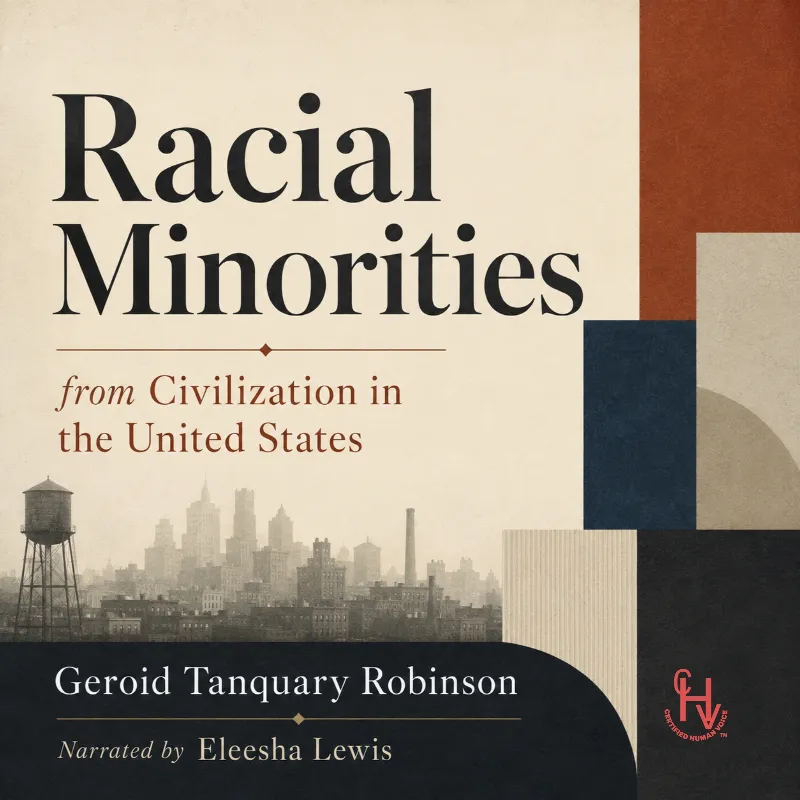
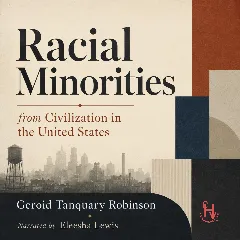
In America, says Geroid Tanquary Robinson, the race problem has not even been properly stated. People make creeds for their economics and religion, but when it comes to race, leaders avoid the question while the crowd acts on emotion.
Hear it read by Eleesha Lewis: the audiobook is right here
Story guide on this page: summary, characters, discussion questions
Yours to keep: a DRM-free EPUB for any device. Read it here, or on Kindle (with Send to Kindle), Apple Books, Kobo or Google Play Books.
Want both? Buy the audiobook and add the ebook for $0.99.
Free audiobook
Listen to the whole story free
Enter your email and we'll send you a link to the full audiobook of Racial Minorities (from Civilization in the United States). No account needed.
We'll also ask if you'd like new audiobooks by email. Privacy Policy
✓ DRM-free, yours to keep. Download the files after you buy and play them anywhere.
Yours to keepBuy once, it stays in your library
Listen anywhereIn our app on your phone or computer
Bought by mistake, or something wrong with the file? Email apica@academyvoices.com within 14 days for a full refund.
Bought by mistake or something wrong with the audio? Email apica@academyvoices.com within 14 days for a full refund.
About this audiobookAbout this book
In America, says Geroid Tanquary Robinson, the race problem has not even been properly stated. People make creeds for their economics and religion, but when it comes to race, leaders avoid the question while the crowd acts on emotion. He asks what North and South actually hope to achieve.
This essay comes from Civilization in the United States, a 1922 collection edited by Harold Stearns. Read by Eleesha Lewis in an hour and eighteen minutes.
Story guide
Racial Minorities (from Civilization in the United States) summary
Spoiler alert: this summary tells the whole story.
Geroid Tanquary Robinson opens by saying that America's race problem is not only unanswered but has never even been clearly stated. He looks at four racial minorities as the country saw them in 1922: Black Americans, American Indians, Jews and Asian Americans. He argues that science has never proved any race superior or inferior, and that the theory of racial inequality cannot explain why prejudice is fierce in some places and absent in others.
His central idea is that prejudice tends to rise and fall with fear of competition. He points to Southern poor whites who see Black workers as rivals for jobs, to the cooling of hatred toward Indians once they were confined to reservations, to anti-Jewish feeling as Jewish Americans succeeded in business, and to Californians who now turn their anger on Japanese farmers. He lists the many forms of repression in both South and North: segregation, Jim Crow laws, denial of the vote, lynching, the revived Ku Klux Klan, the race riots in Chicago and Washington, and new laws against Japanese land ownership.
Robinson argues that prejudice also damages the majority. In the South, he writes, the belief in inborn superiority has bred laziness and a narrow, stifling provincialism, and the same smugness has spread across the country. He describes how Black Americans, cut off from African culture by slavery, have taken on American culture, and how continued rejection has led a few to a new race pride, seen in the Universal Negro Improvement Association and its dream of a Black nation in Africa.
He ends with a bleak conclusion. As minorities adopt the majority's culture they become stronger competitors, which only increases prejudice, so the race problem cannot be solved on its own while the country's economic system stays the same. He closes with a list of questions and answers summing up his case.
The essay is a valuable record of how one thoughtful writer of 1922 tried to analyze racism in economic terms, and of the conditions minorities faced at the time.
Famous lines
In America, the race-problem is not only without answer; thus far it is even without formulation.
The opening line
In Dixie it is a career simply to go through life inside of a white skin.
Robinson, on the effects of prejudice on white Southerners
Prejudice does not altogether prevent cultural assimilation; cultural assimilation increases competitive strength without eliminating recognizability; competitive strength plus recognizability produces more prejudice
Robinson, summing up his argument
Main characters
GT
Geroid Tanquary RobinsonThe author, a young historian who later became a scholar of Russia.
JD
Julius DrachslerA researcher whose figures on mixed marriages in New York the essay uses.
SG
Stephen GrahamA British writer whose book The Soul of John Brown the essay quotes on slavery's lasting harm.
Did you know?
Geroid Tanquary Robinson later became a professor at Columbia University and a leading American historian of Russia.
The Universal Negro Improvement Association described in the essay was led by Marcus Garvey, though the essay never names him.
Civilization in the United States had thirty contributors, including H. L. Mencken and Lewis Mumford.
Questions to talk about
Robinson argues that prejudice follows fear of competition. Which of his examples do you find most convincing, and which least?
Why does he believe prejudice harms the majority as well as the minorities?
What does he mean when he says that cultural assimilation can increase prejudice instead of ending it?
Which of his predictions or assumptions from 1922 turned out to be wrong, and which still ring true?
How does the question-and-answer section at the end change the way you read the essay?
Chapters
Racial Minorities (from Civilization in the United States) chapters
ChapterStarts at
Racial Minorities 10:24
Racial Minorities 243:49
New listeners
Get 25% off your first audiobook
Join our list and we'll email you 25% off, plus new releases from our store. Every one is read by a real person. No account needed.
Details
Length
1 hr 18 min
Narration
Solo narrator
Format
Unabridged audiobook
Publisher
Academy Voices
Language
English
ISBN
9798182620963
Questions
What is Racial Minorities (from Civilization in the United States) about?
A 1922 essay arguing that race prejudice in America is driven less by real racial differences than by economic competition, and that it harms the majority as well as the minorities.
Who are the main characters in Racial Minorities (from Civilization in the United States)?
Geroid Tanquary Robinson, the author, a young historian who later became a scholar of Russia; Julius Drachsler, a researcher whose figures on mixed marriages in New York the essay uses; Stephen Graham, a British writer whose book The Soul of John Brown the essay quotes on slavery's lasting harm.
Who narrates the Racial Minorities (from Civilization in the United States) audiobook?
This edition of Racial Minorities (from Civilization in the United States) by Geroid Tanquary Robinson is narrated by Eleesha Lewis.
How long is the Racial Minorities (from Civilization in the United States) audiobook?
It runs 1 hr 18 min, unabridged, so you hear the complete text.
Is this audiobook narrated by a real person?
Yes. Every Academy Voices audiobook is Certified Human Voice: performed start to finish by a real narrator.
Where can I listen to Racial Minorities (from Civilization in the United States)?
Right here: buy it on Academy Voices and listen in your browser or our app. Hear a free sample on this page first.