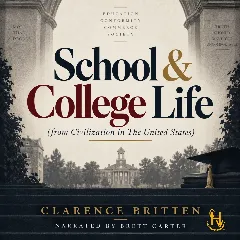
Hear it read by Brett Carter: the audiobook is right here
Story guide on this page: summary, characters, discussion questions
Yours to keep: a DRM-free EPUB for any device. Read it here, or on Kindle (with Send to Kindle), Apple Books, Kobo or Google Play Books.
Want both? Buy the audiobook and add the ebook for $0.99.
Free audiobook
Listen to the whole story free
Enter your email and we'll send you a link to the full audiobook of School & College Life (from Civilization in the United States). No account needed.
We'll also ask if you'd like new audiobooks by email. Privacy Policy
✓ DRM-free, yours to keep. Download the files after you buy and play them anywhere.
Yours to keepBuy once, it stays in your library
Listen anywhereIn our app on your phone or computer
Bought by mistake, or something wrong with the file? Email apica@academyvoices.com within 14 days for a full refund.
Bought by mistake or something wrong with the audio? Email apica@academyvoices.com within 14 days for a full refund.
About this audiobookAbout this book
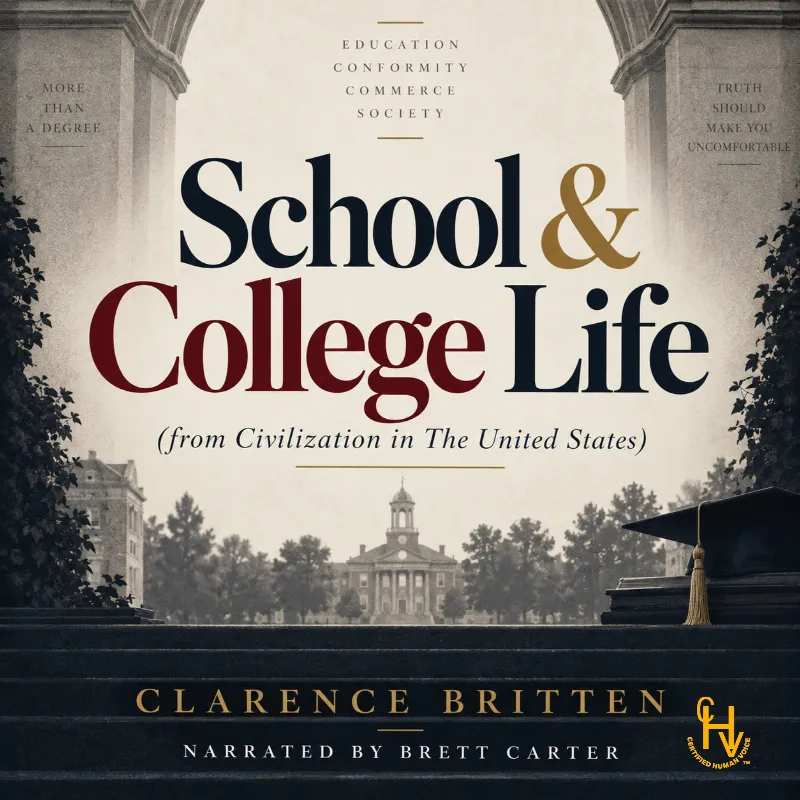
Clarence Britten imagines a visitor from Mars asking what Americans care about most. The answer, he thinks, is education. Everyone believes in it. Few are satisfied with it. Britten then looks at schools and colleges to see what they do and what they fail to do.
This essay comes from Civilization in the United States, a 1922 collection edited by Harold Stearns. Read by Brett Carter in an hour and nine minutes.
Story guide
School & College Life (from Civilization in the United States) summary
Spoiler alert: this summary tells the whole story.
Britten opens with an imagined interview with a visitor from Mars. The Martian says two things strike him about Americans: their passion for education and their sameness. Their cities, churches and colleges are nearly interchangeable, and they all want to be alike, putting on straw hats on the same day and reading the same books. On Mars, he says, schools aim to put young people in touch with many different ideas, so graduates come out with different beliefs and tastes. How can America have the most schooling on Earth and the most uniform people?
Britten agrees the uniformity is real. Railroads, newspapers, the Ford car and the movies are wiping out regional differences, and even East and West are merging. The only class line left is money. Americans prize a mild, negative charm and avoid anyone "conceited," a "knocker" or a "highbrow." Then he looks at what Americans actually want from schools. Parents hand off their children's questions to overworked teachers, push "practical" subjects, and treat high school as a race to a job or a cram course for college entrance exams. Students learn that a C is "a gentleman's mark."
At college, the Martian would rank students' priorities this way: athletics first, then social life, campus politics, and only then study. Sports are exhausting unpaid work for the players and noisy duty for the fans. Each college prizes conformity to its own type and calls itself "democratic," though the money line remains. Freshmen are capped and hazed, and when a Cornell freshman refused to wear his cap, he was ducked in water and the student paper defended it. Clubs and fraternities reward the inconspicuous. Student councils enforce tradition, students vote compulsory chapel back in, and a Brown student paper launches a crusade against the toddle and late parties. Study means doing the least needed to pass.
Still, Britten says, curiosity does break through now and then, in late-night arguments and friendships with an odd classmate or a kind instructor, before the world of duties closes in. The Martian might conclude that education buries curiosity alive. But Britten turns the argument around: schools do not make Americans uniform. Americans made schools in their own image. He traces the "desperate need to agree" to the nation's founding, when very different people united around a few articles of faith in the Declaration of Independence instead of building a shared culture. Americanizing newcomers took the place of becoming a people. He ends with a warning: our luck may not hold, and we may be challenged yet.
Witty and pointed, the essay remains a sharp commentary on school spirit, conformity and what education is really for.
Famous lines
And in nothing are you so alike as in your universal desire to be alike
The Martian
We do not choose, as the Martian suggested, to be as similar as possible; we choose not to be dissimilar.
Clarence Britten
The Martian would conclude that the function of terrestrial education is to bury curiosity alive.
Clarence Britten
For we have made our schools in our own image.
Clarence Britten
Main characters
M
The MartianAn imagined visitor from Mars whose puzzled questions frame the essay.
CB
Clarence BrittenThe author, a critic who examines American schools and colleges.
Did you know?
Civilization in the United States was a famous 1922 collection of essays on American life, edited by the critic Harold Stearns.
Dr. Eliot, whose free elective system Britten praises, was Charles W. Eliot, president of Harvard from 1869 to 1909.
The "genteel tradition" Britten mentions near the end is a phrase made famous by the philosopher George Santayana in a 1911 lecture on American thought.
Questions to talk about
Why does Britten use a visitor from Mars to tell this story? What can an outsider see that we cannot?
He ranks college students' priorities as athletics, social life, politics and study. How would you rank them at schools today?
What does the Cornell freshman cap story show about "tradition" and who enforces it?
Do schools make people alike, or do they simply reflect a society that wants to be alike? Which side does Britten finally take?
Britten says Americans united around ideas instead of a shared culture. What does he think was lost by that?
New listeners
Get 25% off your first audiobook
Join our list and we'll email you 25% off, plus new releases from our store. Every one is read by a real person. No account needed.
Details
Length
1 hr 5 min
Narration
Solo narrator
Format
Unabridged audiobook
Publisher
Academy Voices
Language
English
ISBN
9798182629676
Questions
What is School & College Life (from Civilization in the United States) about?
Clarence Britten imagines a visitor from Mars puzzled that Americans love education yet all think alike, and follows students from kindergarten through college to show that American schools mirror, rather than cause, the nation's conformity.
Who are the main characters in School & College Life (from Civilization in the United States)?
The Martian, an imagined visitor from Mars whose puzzled questions frame the essay; Clarence Britten, the author, a critic who examines American schools and colleges.
Who narrates the School & College Life (from Civilization in the United States) audiobook?
This edition of School & College Life (from Civilization in the United States) by Clarence Britten is narrated by Brett Carter.
How long is the School & College Life (from Civilization in the United States) audiobook?
It runs 1 hr 5 min, unabridged, so you hear the complete text.
Is this audiobook narrated by a real person?
Yes. Every Academy Voices audiobook is Certified Human Voice: performed start to finish by a real narrator.
Where can I listen to School & College Life (from Civilization in the United States)?
Right here: buy it on Academy Voices and listen in your browser or our app. Hear a free sample on this page first.