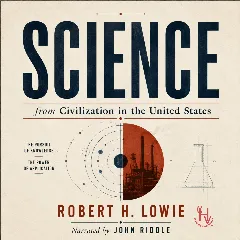
Hear it read by JOHN RIDDLE: the audiobook is right here
Story guide on this page: summary, characters, discussion questions
Yours to keep: a DRM-free EPUB for any device. Read it here, or on Kindle (with Send to Kindle), Apple Books, Kobo or Google Play Books.
Want both? Buy the audiobook and add the ebook for $0.99.
Free audiobook
Listen to the whole story free
Enter your email and we'll send you a link to the full audiobook of Science (from Civilization in the United States). No account needed.
We'll also ask if you'd like new audiobooks by email. Privacy Policy
✓ DRM-free, yours to keep. Download the files after you buy and play them anywhere.
Yours to keepBuy once, it stays in your library
Listen anywhereIn our app on your phone or computer
Bought by mistake, or something wrong with the file? Email apica@academyvoices.com within 14 days for a full refund.
Bought by mistake or something wrong with the audio? Email apica@academyvoices.com within 14 days for a full refund.
About this audiobookAbout this book
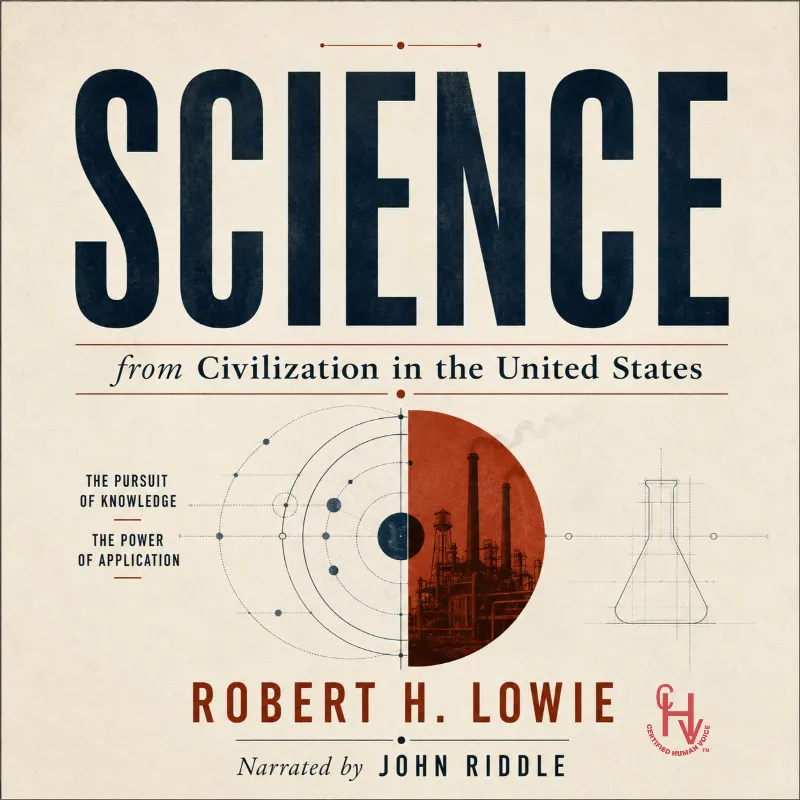
Science asks how American scientific work has been judged, and why it has met less doubt abroad than American art or letters. Robert H. Lowie argues that every sound piece of work adds to the common store of knowledge, however modest, and that American scientists have often gone to Europe to learn their craft first.
This essay comes from Civilization in the United States, a 1922 collection edited by Harold Stearns in which writers took stock of American life. It is read by JOHN RIDDLE in thirty-nine minutes.
Story guide
Science (from Civilization in the United States) summary
Spoiler alert: this summary tells the whole story.
Lowie begins by saying that American science has earned more respect abroad than American art or literature, because in science even ordinary, careful work adds to human knowledge. He then names Americans of real greatness: the physicist Willard Gibbs, the experimenter Albert Michelson, the psychologist William James, the astronomers Simon Newcomb and George W. Hill, the physicist Henry Rowland and the geologist G. K. Gilbert. He also praises whole American schools of work, such as T. H. Morgan's experimental biology and Franz Boas's anthropology.
Yet he says American science is a "hothouse growth," not a natural part of the nation's life. Educated Americans rarely read serious science books, and few top scientists write for the public. Scientists are pushed to present themselves as useful money-makers, and pure research is neglected in favor of practical results. Researchers must flatter rich donors, are buried in teaching and paperwork, and are badly underpaid while university trustees value wealth and position over original thought.
He argues that Americans also suffer from a narrow education. European students arrive at their specialty with a broad cultural background, which helps them see connections an American might miss. He gives the example of Helmholtz, whose knowledge of both medicine and physics let him invent the ophthalmoscope.
Most of all, Lowie wants American scientists to learn "reasoned nonconformism." They should neither worship great names nor sneer at ideas from rival camps, but question their own basic assumptions. Only that habit, spread through the whole culture, will let American science reach its full harvest.
Written for the 1922 collection Civilization in the United States, the essay is a sharp snapshot of American science just after World War I, and many of its complaints about funding and specialization still sound current.
Famous lines
American science, notwithstanding its notable achievements, is not an organic product of our soil; it is an epiphenomenon, a hothouse growth.
Robert H. Lowie
For nothing is more certain than that a penny-wise Gradgrind policy is a pound-foolish one.
Robert H. Lowie
Following Fechner, he will be cautious in his belief but equally cautious in his disbelief.
Robert H. Lowie
Main characters
RH
Robert H. LowieThe author, an American anthropologist writing about his own field and its neighbors.
WJ
William JamesThe psychologist and philosopher Lowie calls America's one scientist who shaped a whole generation's culture.
WG
Willard GibbsA Yale physicist honored abroad but little known at home.
AM
Albert MichelsonThe Chicago physicist whose light experiment underlies relativity.
HR
Henry RowlandA physicist whose 1883 plea for pure science Lowie quotes.
FB
Franz BoasThe anthropologist whose school Lowie credits with remaking the study of culture.
Did you know?
Robert H. Lowie was a student of Franz Boas and became a well-known anthropologist at the University of California, Berkeley.
Albert Michelson, whom Lowie praises, won the 1907 Nobel Prize in Physics, the first American to win a Nobel in the sciences.
"Gradgrind," which Lowie uses to mean a narrow, facts-only mind, comes from a character in Charles Dickens's novel Hard Times.
Questions to talk about
Why does Lowie think ordinary, careful work counts more in science than in art?
What does he mean by calling American science a "hothouse growth"?
Do his complaints about funding, teaching loads and wealthy donors still apply to science today?
What is "reasoned nonconformism," and why does Lowie think scientists need it?
Lowie argues that broad learning helps specialists. Can you think of a discovery that came from combining two fields?
New listeners
Get 25% off your first audiobook
Join our list and we'll email you 25% off, plus new releases from our store. Every one is read by a real person. No account needed.
Details
Length
35 min
Narration
Solo narrator
Format
Unabridged audiobook
Publisher
Academy Voices
Language
English
ISBN
9798182600057
Questions
What is Science (from Civilization in the United States) about?
Anthropologist Robert H. Lowie praises American scientists of his day but argues that science in the United States is cut off from the wider culture, underfunded and too obedient to authority.
Who are the main characters in Science (from Civilization in the United States)?
Robert H. Lowie, the author, an American anthropologist writing about his own field and its neighbors; William James, the psychologist and philosopher Lowie calls America's one scientist who shaped a whole generation's culture; Willard Gibbs, a Yale physicist honored abroad but little known at home; Albert Michelson, the Chicago physicist whose light experiment underlies relativity; Henry Rowland, a physicist whose 1883 plea for pure science Lowie quotes; Franz Boas, the anthropologist whose school Lowie credits with remaking the study of culture.
Who narrates the Science (from Civilization in the United States) audiobook?
This edition of Science (from Civilization in the United States) by Robert H. Lowie is narrated by JOHN RIDDLE.
How long is the Science (from Civilization in the United States) audiobook?
It runs 35 min, unabridged, so you hear the complete text.
Is this audiobook narrated by a real person?
Yes. Every Academy Voices audiobook is Certified Human Voice: performed start to finish by a real narrator.
Where can I listen to Science (from Civilization in the United States)?
Right here: buy it on Academy Voices and listen in your browser or our app. Hear a free sample on this page first.