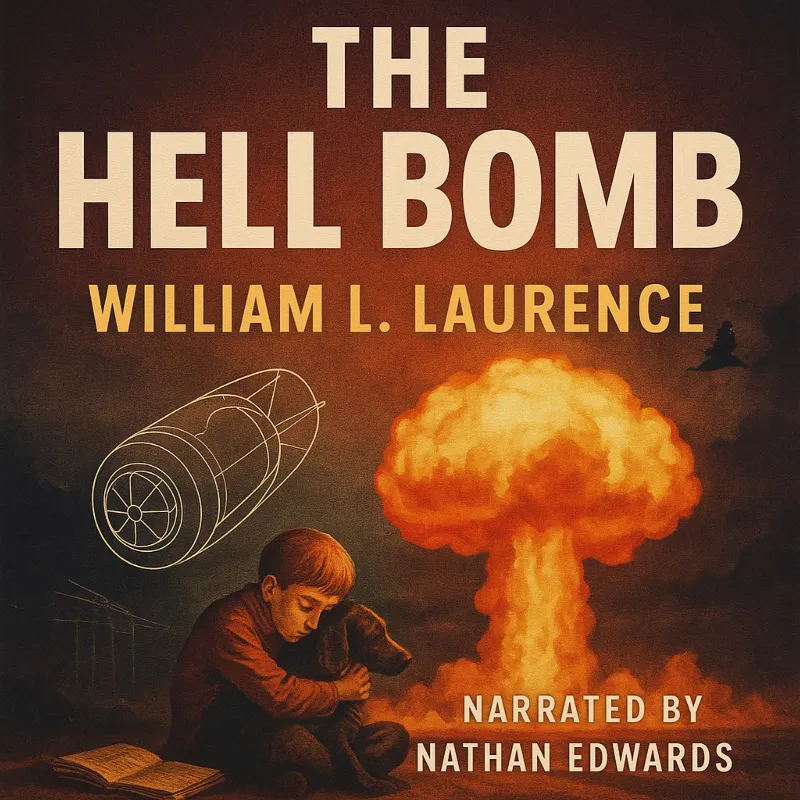
Hear it read by Nathan Edwards: the audiobook is right here
Story guide on this page: summary, characters, discussion questions
Yours to keep: a DRM-free EPUB for any device. Read it here, or on Kindle (with Send to Kindle), Apple Books, Kobo or Google Play Books.
Want both? Buy the audiobook and add the ebook for $0.99.
✓ DRM-free, yours to keep. Download the files after you buy and play them anywhere.
Yours to keepBuy once, it stays in your library
Listen anywhereIn our app on your phone or computer
Bought by mistake, or something wrong with the file? Email apica@academyvoices.com within 14 days for a full refund.
Bought by mistake or something wrong with the audio? Email apica@academyvoices.com within 14 days for a full refund.
About this audiobookAbout this book
In 1950, the United States was deciding whether to build a bomb a thousand times stronger than the one dropped on Hiroshima. William L. Laurence, the New York Times science reporter who had watched the first atomic test, explains in plain terms how fission and fusion work, what the hydrogen bomb would be and what it could do.
He also warns about the cobalt bomb and asks what such weapons mean for the world. Read by Nathan Edwards. Three hours and forty-six minutes.
For readers interested in the history of the Cold War.
Story guide
The Hell Bomb summary
Spoiler alert: this summary tells the whole story.
William L. Laurence, the New York Times science reporter who was allowed inside the wartime atomic bomb project, first heard of the hydrogen bomb at Los Alamos in the spring of 1945. Scientists jokingly called it the "Super." When he asked the physicist Hans Bethe whether it could really be fifty times as powerful as the atomic bomb, Bethe answered that it could be made to equal a million tons of TNT, or even more. In his foreword Laurence stresses that he has seen no secret information and has built his account from published science and his own deductions.
The first two chapters explain the science. The sun shines by fusing hydrogen into helium, and a bomb would try to do the same on Earth. Ordinary hydrogen will not work. A bomb would need the heavy forms of hydrogen called deuterium, found in small amounts in all water, and tritium, which must be made in atomic reactors at great cost. An atomic fission bomb would be needed as the match to light it. Laurence weighs the cost, the materials and the scientists who doubted it could be built.
The third chapter takes up the moral question. After President Truman ordered work on the bomb to continue, twelve leading physicists, including Bethe, urged the United States to pledge never to use it first. Laurence examines their arguments closely and disagrees, warning that the Soviet Union might build the bomb within a few years and use it as the greatest blackmail weapon in history. Written a month after the Korean War began, the fourth chapter argues that the attack on South Korea shows the danger of giving up atomic weapons and that the H-bomb should be finished as fast as possible, perhaps within a year.
The final chapter is a primer on atomic energy for general readers, covering matter and energy, atoms, Einstein's famous formula, and how fission and fusion release power. An appendix from a government report reviews the plans for international control of atomic weapons, from the Acheson-Lilienthal report and the Baruch proposals at the United Nations to Soviet objections, and lists open questions about controlling hydrogen bombs.
The book is a vivid record of how the hydrogen bomb was explained and debated at the very start of the nuclear arms race, by a writer who had stood at the birth of the atomic age.
Famous lines
I first heard about the hydrogen bomb in the spring of 1945 in Los Alamos, New Mexico,
Laurence, the opening line
Yes,” he said, “it could be made to equal a million tons of TNT.” Then, after a pause: “Even more than a million.
Hans Bethe, to Laurence
there can be only one justification for our development of the hydrogen bomb, and that is to prevent its use.
Twelve physicists, quoted by Laurence
Main characters
WL
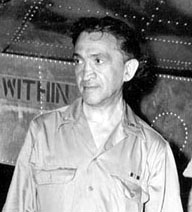
William L. LaurenceThe author, a science reporter who witnessed the birth of the atomic bomb.
HA
Hans A. BetheThe Cornell physicist who explained how the sun burns hydrogen and who told Laurence what an H-bomb could do.
JR
J. Robert OppenheimerThe director of Los Alamos, who assigned scientists to guide Laurence there.
PH
President Harry S. TrumanThe president who ordered work on the hydrogen bomb to continue in 1950.
AE
Albert EinsteinThe physicist whose formula explains atomic energy, quoted on the H-bomb as a probably attainable goal.
Did you know?
Laurence was the only reporter present at the Trinity test, the first atomic bomb explosion, in July 1945.
He won two Pulitzer Prizes for his science reporting.
The first full-scale American hydrogen bomb test took place in November 1952, about two years after Laurence wrote this book.
Questions to talk about
Laurence says he used no secret information. Why do you think he made that point so strongly in the foreword?
The twelve physicists wanted a pledge never to use the H-bomb first. What were their reasons, and why did Laurence disagree?
How did the start of the Korean War change Laurence's argument? Was he right that it "cleared the air"?
What makes the science chapters easy or hard to follow for a general reader? How does Laurence use comparisons to help?
Knowing how the arms race unfolded, how do you judge the book's arguments today?
Chapters
The Hell Bomb chapters
ChapterStarts at
Introduction0:16
Chapter 13:06
Chapter 244:52
Chapter 31:28:31
Chapter 42:15:20
Chapter 52:53:57
New listeners
Get 25% off your first audiobook
Join our list and we'll email you 25% off, plus new releases from our store. Every one is read by a real person. No account needed.
Details
Length
3 hr 46 min
Narration
Solo narrator
Format
Unabridged audiobook
Publisher
Academy Voices
Language
English
ISBN
9798347359011
Questions
What is The Hell Bomb about?
Written in 1950 by the reporter who witnessed the first atomic bomb, this book explains in plain language how a hydrogen bomb would work and argues that the United States must build it before the Soviet Union does.
Who are the main characters in The Hell Bomb?
William L. Laurence, the author, a science reporter who witnessed the birth of the atomic bomb; Hans A. Bethe, the Cornell physicist who explained how the sun burns hydrogen and who told Laurence what an H-bomb could do; J. Robert Oppenheimer, the director of Los Alamos, who assigned scientists to guide Laurence there; President Harry S. Truman, the president who ordered work on the hydrogen bomb to continue in 1950; Albert Einstein, the physicist whose formula explains atomic energy, quoted on the H-bomb as a probably attainable goal.
Who narrates The Hell Bomb audiobook?
This edition of The Hell Bomb by William L. Laurence is narrated by Nathan Edwards.
How long is The Hell Bomb audiobook?
It runs 3 hr 46 min, unabridged, so you hear the complete text.
Is this audiobook narrated by a real person?
Yes. Every Academy Voices audiobook is Certified Human Voice: performed start to finish by a real narrator.
Where can I listen to The Hell Bomb?
Right here: buy it on Academy Voices and listen in your browser or our app. Hear a free sample on this page first.