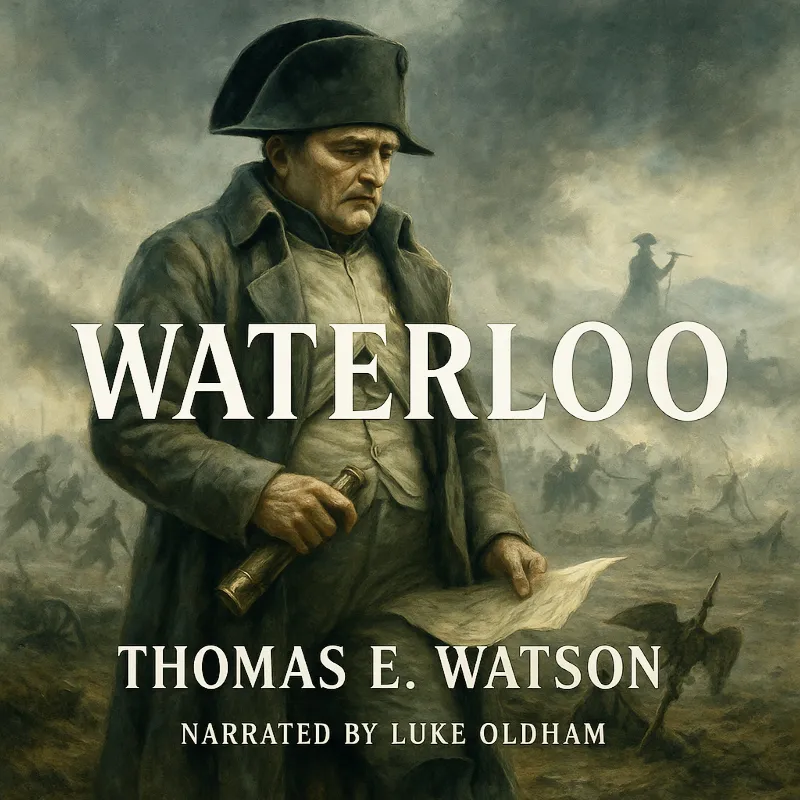
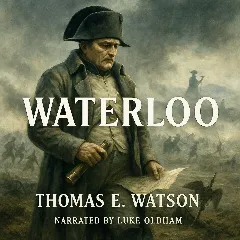
Thomas E. Watson tells the story of the Waterloo campaign, from Napoleon's return from Elba to the battle itself. He looks at what the generals did, what they failed to do and why accounts of the day do not agree.
Hear it read by Luke Oldham: the audiobook is right here
Story guide on this page: summary, characters, discussion questions
Yours to keep: a DRM-free EPUB for any device. Read it here, or on Kindle (with Send to Kindle), Apple Books, Kobo or Google Play Books.
Want both? Buy the audiobook and add the ebook for $0.99.
✓ DRM-free, yours to keep. Download the files after you buy and play them anywhere.
Yours to keepBuy once, it stays in your library
Listen anywhereIn our app on your phone or computer
Bought by mistake, or something wrong with the file? Email apica@academyvoices.com within 14 days for a full refund.
Bought by mistake or something wrong with the audio? Email apica@academyvoices.com within 14 days for a full refund.
About this audiobookAbout this book
Thomas E. Watson tells the story of the Waterloo campaign, from Napoleon's return from Elba to the battle itself. He looks at what the generals did, what they failed to do and why accounts of the day do not agree.
A history written in 1908 by an American author who wrote also on Napoleon, read by Luke Oldham. Just over three hours.
For listeners who like military history told in a lively voice.
Story guide
Waterloo summary
Spoiler alert: this summary tells the whole story.
Thomas E. Watson, an American politician and writer who greatly admired Napoleon, tells the story of the Hundred Days' final act. Napoleon has escaped from Elba and retaken France without a shot, but Paris is cool toward him, many of his old marshals are dead or gone, and the armies of Europe are gathering against him. In June 1815 he rides north to strike the British and Prussian armies in Belgium before they can join together.
Watson follows the campaign day by day. Napoleon beats the Prussians under Blücher at Ligny, while Marshal Ney fights Wellington to a standstill at Quatre Bras. But the French fail to follow up their gains. Marshal Grouchy is sent after the retreating Prussians with a large part of the army, and he never finds them in time.
On Sunday, June 18, Napoleon attacks Wellington's army at Mont-Saint-Jean, near the village of Waterloo. Watson describes the bloody fight for the farm and château of Hougoumont, the failed infantry assault, Ney's huge and premature cavalry charges, and the long afternoon as Blücher's Prussians arrive on the French flank instead of Grouchy. The last charge of the Imperial Guard breaks, and the French army dissolves in flight.
Watson then weighs the mistakes on each side. He lists Napoleon's errors frankly, praises Wellington's handling of the battle as nearly faultless, and adds short portraits of Blücher and of Ney, the "Bravest of the Brave," who was not himself in this campaign. He closes with Napoleon's second abdication, his exile, and a dramatic account of his death on St. Helena in 1821.
The book is a fast, dramatic read that brings the battlefield to life. It is also openly partisan, which makes it a good starting point for talking about how history gets told and who gets the credit.
Famous lines
How, then, can any one expect to learn exactly what occurred on Sunday, June 18th, 1815, in front of the village of Mont-Saint-Jean?
The author, in the introduction
Few partisans of Napoleon now contend that he was free from serious fault in this, his last campaign.
The author
All will go well now—Red-head is with us!
French soldiers, on Marshal Ney's arrival
Main characters
NB
Napoleon BonaparteThe French Emperor, back from exile and gambling everything on one campaign.
DW
The Duke of WellingtonThe British commander who holds the ridge at Mont-Saint-Jean.
GV
Gebhard von BlücherThe tough old Prussian field marshal whose army arrives to decide the battle.
MN
Marshal NeyNapoleon's bravest general, timid at Quatre Bras and reckless at Waterloo.
MG
Marshal GrouchyThe French commander sent after the Prussians who never reaches the battlefield.
MS
Marshal SoultNapoleon's chief of staff, who warns him about the strength of the British.
Did you know?
Thomas E. Watson was a Georgia congressman and later a U.S. senator, and he ran for vice president on the Populist ticket in 1896.
Watson also wrote a full biography, Napoleon: A Sketch of His Life, Character, Struggles, and Achievements, published in 1902.
The battle is named for Waterloo because Wellington wrote his victory dispatch from his headquarters in that village, even though most of the fighting happened a few miles south.
Questions to talk about
Watson clearly admires Napoleon. Where does that admiration show, and does it make the book more or less trustworthy?
Which of Napoleon's mistakes, as Watson lists them, seems most important to you? Why?
How much did chance, such as the rain and Grouchy's delay, decide the battle?
Watson argues that Waterloo was first claimed as an English victory. Why might nations tell the same battle differently?
What does the portrait of Ney say about courage and judgment?
Chapters
Waterloo chapters
ChapterStarts at
Introductory0:17
Chapter 111:30
Chapter 235:24
Chapter 353:18
Chapter 41:05:26
Chapter 51:16:27
Chapter 61:21:15
Chapter 71:41:09
Chapter 81:49:13
Chapter 92:34:52
Show all 11 chapters
A Supplementary Chapter2:55:58
New listeners
Get 25% off your first audiobook
Join our list and we'll email you 25% off, plus new releases from our store. Every one is read by a real person. No account needed.
Details
Length
3 hr 12 min
Narration
Solo narrator
Format
Unabridged audiobook
Publisher
Academy Voices
Language
English
ISBN
9798347386017
Questions
What is Waterloo about?
A vivid, opinionated history of Napoleon's last campaign in June 1815, from his march into Belgium to his defeat at Waterloo and his death on St. Helena.
Who are the main characters in Waterloo?
Napoleon Bonaparte, the French Emperor, back from exile and gambling everything on one campaign; The Duke of Wellington, the British commander who holds the ridge at Mont-Saint-Jean; Gebhard von Blücher, the tough old Prussian field marshal whose army arrives to decide the battle; Marshal Ney, napoleon's bravest general, timid at Quatre Bras and reckless at Waterloo; Marshal Grouchy, the French commander sent after the Prussians who never reaches the battlefield; Marshal Soult, napoleon's chief of staff, who warns him about the strength of the British.
Who narrates the Waterloo audiobook?
This edition of Waterloo by Thomas E. Watson is narrated by Luke Oldham.
How long is the Waterloo audiobook?
It runs 3 hr 12 min, unabridged, so you hear the complete text.
Is this audiobook narrated by a real person?
Yes. Every Academy Voices audiobook is Certified Human Voice: performed start to finish by a real narrator.
Where can I listen to Waterloo?
Right here: buy it on Academy Voices and listen in your browser or our app. Hear a free sample on this page first.