Audiobook Royalty Rates by Store: What Each One Keeps
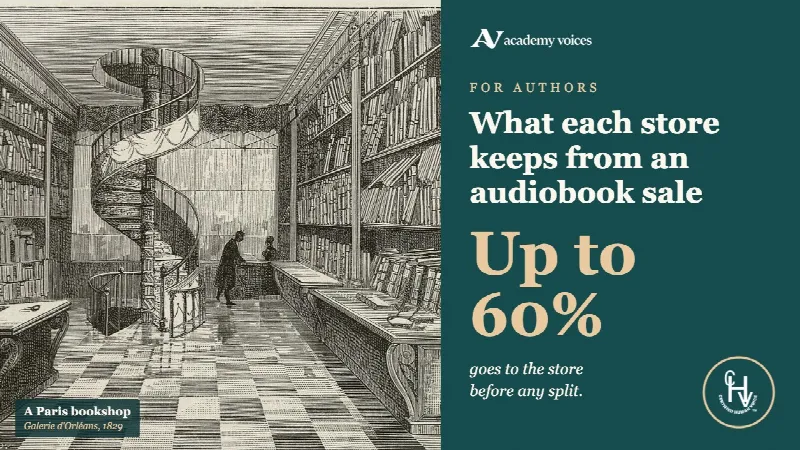
Audiobook royalty rates depend on the store and on how your book gets there. Upload direct and Kobo pays 45% of list price, Spotify 50% on purchases, and ACX 50% or 30% of a share of Audible's member money. Go through a distributor and stores pay it 40% to 50% of list, and it keeps 20% of that. Selling direct, only the card fee comes out.
An author asked us this by email: "Royalty share is split on net. And that cut is?" It's the right question. "Net" means after someone else has been paid, and most royalty pages never say who. This post goes store by store, from each company's own terms, so you can see every cut before the split.
Who takes a cut before "net"?
Two companies, sometimes three, take their share before any royalty split happens.
- The store. Audible, Apple, Kobo, Spotify, a library app. It sets the price the listener pays, or works from yours, and keeps its share. This is the biggest cut.
- The distributor. If the store doesn't take uploads from you, a distributor delivers the book and collects the money. Most keep 20% of what the store pays them.
- The card processor. Only on sales you make yourself. Stores pay their own card fees out of their share.
What's left after those is net royalties. If you published the book yourself, net is yours. If a publisher distributed it, the publisher's contract splits net. That's where 80/20 or 40/40/20 comes in, and it's the last step, not the first.
So when someone quotes you a royalty percentage, ask two things. A percentage of what? And who has already been paid? The rest of this post answers both for each store.
Audiobook royalty rates, store by store
Here is what each store says it pays, from its own terms or help pages. Where a store doesn't publish a rate, we say so instead of guessing.
| Store | How you get in | How it pays | Published rate |
|---|---|---|---|
| Audible and Amazon (ACX) | Direct upload | Member money spread across titles listened to, plus sales | 50% exclusive or 30% non-exclusive (new model) |
| Kobo | Direct upload or distributor | Sale or subscription copy | 45% of list price at $2.99 and up, 35% below, 32% for subscription copies |
| Spotify | Direct upload or distributor | Purchase, or Premium listening pool | 50% of your price on purchases; Premium from a pool by share of listening |
| Google Play | Direct upload or distributor | Sale, paid on list price | Not published for audiobooks (ebooks: 70%, or 52% by default) |
| Apple Books | Approved distributor only | Sale | Not published |
| Libraries (OverDrive, hoopla) | Distributor | Library buys a copy, or pays per borrow | Not published |
| Any store, through a distributor | Distributor | Depends on the store | Stores pay 40% to 50% of list on sales; distributor keeps 20% |
| Your own site or our store | Direct | Sale | Price less about 2.9% plus 30 cents card fee |
Sources are linked in each section below. Rates as of November 2026.
Audible and Amazon, through ACX
ACX is the only way to upload to Audible yourself. Since May 26, 2026 it has run a new royalty model, and its royalty page says the old one ends at year-end, when every title has to move over. The new rates are 50% if you're exclusive and 30% if you're not. The old ones were 40% and 25%.
Those percentages are not a share of your list price. Most Audible listening is by members. ACX takes what each member's plan brought in, less taxes and fees, and divides it across the titles that member listened to, weighted by price. Your rate applies to your slice. ACX's own example, under the old model: a $30 book at 40% paid "about $6.00". That's 20% of the regular price.
Two more cuts are easy to miss. Exclusive means ACX distributes the book everywhere it sells, Apple Books included, and you can't sell it anywhere else. And a royalty share deal on ACX must be exclusive, with your rate split in half between you and the narrator, for seven years. We covered the new model in ACX royalty changes in 2026.
Kobo
Kobo is the clearest of the big stores. Its Writing Life terms pay 45% of your suggested price on each audiobook sold, if that price is $2.99 or more in the US. Below that it's 35%. When Kobo buys a copy for its subscription service, it pays 32%.
So a $14.99 audiobook sold on Kobo pays you $6.75 if you uploaded it yourself. Through a distributor, Kobo pays the distributor, and the distributor keeps its share before you see it.
Spotify
Spotify pays two ways. Its Spotify for Authors terms pay 50% of the price you set when a listener buys the book. When a Premium subscriber listens as part of their monthly hours, Spotify pays from a pool for each country, split by each book's share of all listening.
The purchase rate is simple. The Premium side has no fixed rate, so nobody can tell you in advance what a listen is worth. On our own catalog, Spotify listening paid small amounts many times. Our per-sale royalty post has what that came to per listen.
Google Play
Google Play takes audiobook uploads through its Partner Center. Its revenue split page says Google pays on the list price, not the sale price, and charges no fees on top. The rates it publishes, 70% in most countries or 52% by default, are written for ebooks. We couldn't find a published audiobook rate. If you upload direct, check the rate in your own Partner Center agreement before you count on it.
Apple Books
Apple doesn't take audiobooks from authors directly. Its audiobooks page sends you to one of its approved distribution partners, and Author's Republic and Voices by INaudio are both in its partner directory. Apple doesn't publish what it pays those partners. That makes Apple a distributor store for almost every independent author: the store's share comes out first, then the distributor's 20%.
Libraries: OverDrive (Libby) and hoopla
Library apps don't pay a percentage of a sale. OverDrive mostly sells libraries a copy. Its lending models sheet lists one copy for one reader at a time, copies that expire after a set number of checkouts or months, and copies many readers can share. hoopla charges the library each time a patron borrows. Neither publishes what it pays authors, and neither takes uploads from individual authors. You reach both through a distributor.
Through a distributor
A distributor sends your book to the stores you can't reach yourself, and to the ones you could but don't want to manage one by one. Voices by INaudio's help article, How much will I make per sale?, gives the ranges stores pay: 40% to 50% of list price on sales, 30% to 40% on subscriptions, and 25% to 45% of receipts where a store shares revenue. INaudio pays the author 80% of what it receives. Author's Republic also pays 80% of earned royalties.
So on a sale by the copy, you end up with 32% to 40% of list price. The distributor's 80% sounds like most of the sale. It's 80% of what the store passed along.
Selling direct
When the listener buys from you, or from a store that is also the publisher, there's no store cut and no distributor. The only cost is the card fee. Stripe charges 2.9% plus 30 cents on a US card. On a $14.99 sale that's $0.73, so $14.26 is left. That is the most any route pays per sale. The catch is that you have to bring the buyers.
The Author Audiobook Checklist
What it costs, how to choose a narrator, the three ways to pay, and what happens after you publish.
Is it better to upload direct or use a distributor?
Direct pays more per sale where it's possible. Kobo direct pays you 45% of list. Through a distributor, even if Kobo paid the distributor the same 45%, the distributor's 20% leaves you 36%. On a $14.99 book that's $6.75 against about $5.40.
But direct only covers a handful of stores, and each one is a separate account, a separate upload, a separate report and a separate payment. A distributor covers Apple, libraries, subscription apps and dozens of smaller stores you can't reach alone. For most authors the 20% buys more sales than it costs.
Many authors do both: direct where it's easy, a distributor for the rest. Just check that your distributor lets you leave out the stores you upload to yourself, so the same book doesn't go up twice.
One thing doesn't mix with either. If you go exclusive on ACX, every other store on this list is closed to that book, libraries and Spotify included.
What "net" means when we publish your audiobook
Back to the email. When we publish a book, new titles go out through Author's Republic to nearly 50 stores, libraries and streaming services, Audible included, without exclusivity. Each store keeps its share. Author's Republic keeps 20% of what the store pays. What reaches us is net royalties, and we split that. Our facts page puts it in one line: royalty percentages apply to what reaches Academy Voices after each store and distributor takes its share.
We don't take anything else out first. No file fees, hosting fees or report fees. Then net is split by the deal you chose:
- Per finished hour. You pay your narrator the rate you set, from $50 per finished hour, and own the audio. Net is split 80% to you and 20% to us. You can pay the narrator all at once, in 2 to 5 parts, or over time with Klarna or Affirm, if approved.
- Royalty share. You pay a $350 production fee and nothing to the narrator. Net is split 40% to you, 40% to your narrator and 20% to us, for 10 years. After that the narrator's share comes to you.
- You already have the audio. We publish it everywhere for $150, and you keep 80% of net.
Sales in our own store work the same way, minus one step. There's no outside store and no distributor, so net is the price less tax and the card fee. If you only want your finished audiobook in our store, without us distributing it, listing is free and you keep 70% of net.
One $14.99 audiobook, every route
Here is the same sale, $14.99 at full price, followed to the rights holder by each route. This is what one sale is worth. It says nothing about how many sales each store brings, and that matters more.
| Route | Who takes a cut | Reaches you |
|---|---|---|
| Kobo, uploaded yourself | Kobo 55% | $6.75 |
| Spotify purchase, uploaded yourself | Spotify 50% | $7.50 |
| Any store sale, through a distributor | Store 50% to 60%, then distributor 20% | $4.80 to $6.00 |
| With us, per finished hour, store sale | Store, Author's Republic, then 20% to us | $3.84 to $4.80 |
| With us, royalty share, store sale | Store, Author's Republic, then 40% narrator and 20% us | $1.92 to $2.40 |
| Our store, per finished hour | Card fee, then 20% to us | $11.40 |
| Our store, royalty share | Card fee, then 40% narrator and 20% us | $5.70 |
| Our store, listing only | Card fee, then 30% to us | $9.98 |
| Your own site | Card fee and your delivery tool | about $14.26 before your tool's fee |
Distributor rows use INaudio's published 40% to 50% range for store sales. Audible is left out because ACX doesn't pay a share of list price. Our store sells a book of 8 to 15 hours at $14.99. Tax, if any, is not part of anyone's royalty.
Two things stand out. The store's share is the biggest cost on every route except direct sales. And on royalty share, your narrator is paid out of the same net you are, so their share is the same size as yours. That's the trade for paying nothing to the narrator up front.
How to use these numbers
Don't pick a route from one row of a table. Do this instead.
- Find where your readers buy. If they all live on Audible, Audible's rules matter most. If they borrow from libraries or use Spotify, an Audible-exclusive deal shuts them out.
- Price for the store, not the percentage. Kobo's 45% only starts at $2.99. Audible sets its own price by length. A higher rate on a store your readers don't use pays nothing.
- Count the hours you'll spend. Every direct account is more uploads, more reports and more tax forms. A distributor's 20% is often cheaper than your time.
- Send your own readers to a direct sale. Your newsletter list and your website are the one place you control the buyer. That's where the card fee is the only cut.
For what these rates actually came to on two years of our own sales, per copy and per listen, read audiobook royalties: where every dollar of a sale goes. To choose between paying your narrator and sharing royalties, read royalty share vs per finished hour. And if you want to sell direct, we compared the options in where to sell your audiobook besides Audible.
Where to start
Post your book with us for free. Real narrators audition, every one a real person in their own voice, and every audiobook carries our Certified Human Voice promise. You pick the narrator, choose per finished hour or royalty share, and your royalties show on your dashboard store by store, so you can check every cut in this post against your own book. See how it works.
Questions authors ask
What percentage does Audible take from an audiobook sale?
It isn't a fixed share of your price. Through ACX you earn 50% if exclusive or 30% if not, applied to your slice of what members paid. ACX's own example works out to about 20% of the regular price.
What does "net royalties" mean for an audiobook?
What's left after the store and the distributor take their share. With us, it's what Author's Republic pays us for your book. Nothing else comes out before the split.
How much do audiobook distributors take?
Voices by INaudio and Author's Republic both pay 80% of what the store pays them, so they keep 20%. That comes after the store's own share.
Can I upload my audiobook directly to Apple Books?
No. Apple takes audiobooks only through approved distribution partners. Author's Republic and Voices by INaudio are both on its list.
What royalty does Kobo pay on audiobooks?
45% of your price on sales at $2.99 or more, 35% below that, and 32% for copies bought for its subscription service.
Which route pays the most per sale?
A direct sale, from your own site or our store. Only the card fee comes out, about $0.73 on a $14.99 book. The big stores pay less per sale but bring their own buyers.
Rates are from ACX, Kobo, Spotify, Google, Apple, OverDrive, INaudio, Author's Republic and Stripe's own pages as of November 2026. Our terms are from our facts page. We'll update this post if they change.
The Author Audiobook Checklist
What it costs, how to choose a narrator, the three ways to pay, and what happens after you publish.