Where to Sell Your Audiobook Besides Audible (2026)
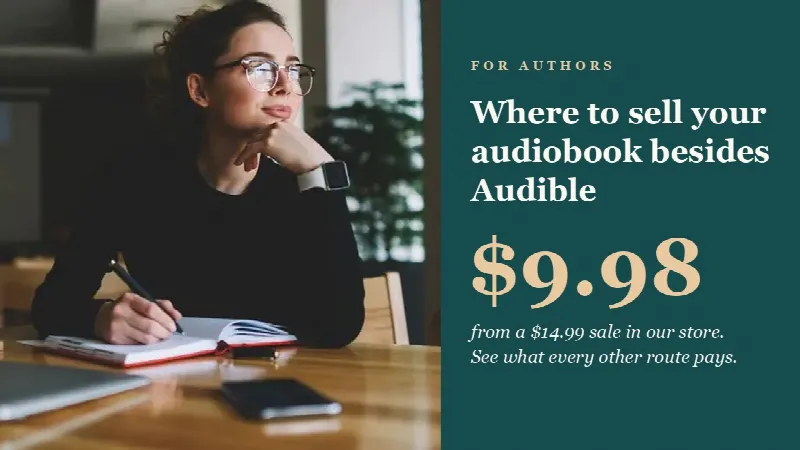
You can sell your audiobook besides Audible in three ways: list it directly with a store that takes uploads, send it to many stores at once through a distributor, or sell it from your own website. All three need the same thing first. Your audiobook can't be under an exclusive deal with Audible.
We publish audiobooks for a living. Since 2023 we've put out hundreds of them through Audible, through distributors and now through our own store, so we've seen what each route pays and what each one costs you in time. This is the honest version, with the rates each company publishes and where we found them.
First, check that you're allowed to sell it anywhere else
If your audiobook went up through ACX, you chose exclusive or non-exclusive distribution when you set it up. ACX says exclusive means your audiobook is sold only through Audible, Amazon and Apple Books. Non-exclusive means you keep the right to sell it anywhere.
To check, log in to ACX and open the title. It shows the distribution as Exclusive or Non-exclusive. Another tell: if the only places you can find your audiobook are Audible, Amazon and Apple Books, it's probably exclusive.
If it's exclusive, don't list it anywhere else yet. ACX gives Audible the right to distribute your audiobook for seven years. ACX said in 2021 that rights holders who paid for their own production can ask to move to non-exclusive after the audiobook has been on sale for 90 days, and that royalty share titles need the narrator to agree. ACX rewrote its agreements in 2026, so ask ACX support what applies to your title before you count on it.
Moving to non-exclusive changes your Audible rate. Under Audible's new royalty model, exclusive titles earn 50% and non-exclusive titles earn 30%. The older rates, 40% and 25%, stay for existing titles until the end of 2026. So going wide costs you some Audible income. The question is whether the other stores make up for it.
Stores that take your audiobook directly
A direct store is one where you make an account, upload your files and get paid by the store itself. Nobody sits in the middle. There aren't many.
- Kobo Writing Life. Kobo pays 45% of the list price on a regular sale priced at $2.99 or more, and 32% when a subscriber spends a credit. Kobo says you never have to be exclusive. You set the price. The audiobook tab is still being rolled out, so you may have to email them to get it switched on.
- Spotify for Authors. You upload directly. Spotify pays one royalty for sales and another for listening by Premium subscribers, and reports them separately. The Premium rate isn't published.
- Our store, Academy Voices. We take finished audiobooks directly. It's free to list, you keep 70% of net sales, and there's no term. More on that below.
A direct store is the simplest route. One account, one upload, one payment. The limit is reach. Each one only puts you in front of its own listeners.
Stores you can only reach through a distributor
Most of the well-known audiobook stores don't let a single author upload. They take audiobooks from distributors.
- Apple Books. Apple takes audiobooks through its approved partners, and says there are no exclusivity requirements.
- Chirp. BookBub says authors list on Chirp through INaudio or Author's Republic. Chirp sells limited-time deals, so most sales there are at a low price.
- Libro.fm. Libro.fm points self-produced audiobooks to Author's Republic. It shares its profit with independent bookstores.
- Libraries. Library apps like Libby and Hoopla mostly get independent audiobooks from distributors too.
The two distributors most independent authors use are Voices by INaudio, which used to be Findaway Voices, and Author's Republic. Each one sends your audiobook to dozens of stores and libraries from a single upload.
Here's the part authors miss. A distributor's rate is a share of what the store pays, not of your price. INaudio says stores that sell by the copy pay 40% to 50% of the list price, and that you keep 80% of that. Author's Republic also pays 80% of earned royalties. Put together, a $14.99 sale usually leaves you about $4.80 to $6.00.
That isn't a bad deal. One upload reaches listeners and libraries you'd never reach alone, and you don't chase 40 companies for payment. It's just a smaller slice of each sale than the 80% makes it sound.
Selling from your own website
You can also skip stores entirely. Put a checkout on your own site and deliver the files yourself. Authors usually pair a checkout tool with a delivery tool.
- Checkout. Payhip's free plan takes 5% of each sale. Card fees are extra.
- Delivery. BookFunnel charges a yearly plan plus an audio add-on. It gives your listener an app to play the audiobook in, which a plain download doesn't.
On a $14.99 sale you'd keep about $13.50 after Payhip's cut and the card fee, before the yearly cost of delivery. That's the most you'll keep per sale anywhere.
The catch is that your website has no shoppers of its own. Every sale comes from a reader you already have: your email list, your social following, the back of your ebook. You also handle sales tax and customer questions. Direct sales work well for authors with an audience. They don't find you a new one.
What one $14.99 sale pays you
Rates are hard to compare because companies measure them differently. Some pay a share of your list price. Audible pays a share of what it actually collected, or of a pool. A distributor pays a share of what the store paid it. This table puts them on the same footing: one full-price sale at $14.99.
| Where it sells | How it pays | You receive |
|---|---|---|
| Your own website (Payhip free plan) | 95% less the card fee, plus yearly delivery cost | About $13.50 |
| Academy Voices store | 70% of the price less sales tax and the card fee | About $9.98 |
| Kobo, direct | 45% of list price | $6.75 |
| Kobo, direct, bought with a credit | 32% of list price | $4.80 |
| Stores through a distributor | 80% of the 40% to 50% the store pays | $4.80 to $6.00 |
| Audible, exclusive | 50% of net receipts or member value | $7.50 at most |
| Audible, non-exclusive | 30% of net receipts or member value | $4.50 at most |
Our arithmetic from each company's published rates. Audible sets the selling price and pays members' listens from a pool, so its figures are ceilings, not typical amounts. Card fee taken as 2.9% plus 30 cents.
Read that table carefully. A bigger share of a sale is not more money unless people buy. Audible has far more listeners than any other store on this list. Our store is new. What the table shows is what each sale is worth when it happens, and what each route costs you. It says nothing about how many sales you'll get.
That's the case for not choosing. If your audiobook is non-exclusive, it can be on Audible for reach, at the distributor stores and libraries for breadth, and in a direct store for the best rate, all at once.
How it works in our store
We opened the Academy Voices store in October 2026. Listeners buy an audiobook once and play it on their phone or computer. There's no subscription and no credits.
If you already have a finished audiobook, you can list it in our store. Here are the terms.
- Free. No listing fee and no yearly fee.
- 70% to you. You keep 70% of net sales, which is the price the listener pays less sales tax and the card fee. We keep 30%.
- Not exclusive. Keep selling it everywhere else.
- No term. Take it down whenever you like. Listeners who already bought it keep it.
- We set the price, by length. $4.99 under 3 hours, $9.99 for 3 to 8 hours, $14.99 for 8 to 15 hours and $19.99 above that.
There are two rules. You have to own the audio rights, and the audiobook has to be read by a real person. We don't sell audiobooks made with a computer-generated voice. Every audiobook in the store is Certified Human Voice. Your files also have to pass the same audio check the big stores use. Our free audio tools tell you what to fix before you upload.
If you'd rather hand the whole thing off, there's a second option. For a one-time $150 we publish your finished audiobook to nearly 50 retailers, libraries and streaming services, and to our own store. On that one you keep 80% of net royalties and we keep 20%. You can see both side by side on the List Your Audiobook page, and browse the store to see who you'd be next to.
Don't have an audiobook yet? That's the other half of what we do. Post your book free, real narrators audition, and you pick the voice. How It Works covers the cost.
Which route should you pick?
Start from what you have, not from the rate.
- You have an email list or a following. Sell from your own website, and add stores for the listeners who won't buy from a site they don't know.
- You have no audience yet. Go where listeners already are. Use a distributor for the big stores and libraries, and keep Audible non-exclusive.
- You have several audiobooks. Do all of it. The work is mostly in the first upload. After that each new store is a copy of the last one.
- You're exclusive with Audible and happy. Stay. Exclusive pays the higher Audible rate, and for some books Audible is nearly all the sales. Look again when your term is up.
Whatever you pick, keep your own master files, your cover at full size and a list of where each audiobook is on sale. Stores change their terms. Audible changed its whole royalty model in 2026. The authors who came through that best were the ones who could move.
Questions authors ask
Can I sell my audiobook on Audible and other stores at the same time?
Yes, if your ACX distribution is non-exclusive. You'll earn the lower Audible rate, 30% under the new model, and you can sell everywhere else. If it's exclusive, you can't sell it outside Audible, Amazon and Apple Books.
How do I get out of ACX exclusivity?
Ask ACX support. In 2021 ACX said self-produced and paid-for titles could move to non-exclusive after 90 days on sale, and that royalty share titles need the narrator's agreement. Confirm what applies under your current agreement before you list anywhere else.
Which store pays authors the most per sale?
Your own website does, because only the checkout and card fees come out. Among stores with their own listeners, the rates we found run from 30% at Audible non-exclusive to 45% at Kobo to 70% in our store. Rate isn't income, though. A store has to have buyers.
Do I need a distributor?
Only for the stores that don't take uploads from authors, such as Apple Books, Chirp, Libro.fm and library apps. You can use a distributor for those and still list directly with stores that take you, as long as you don't send the same store your audiobook twice.
Do I need an ISBN to sell my audiobook?
It depends on the store. Author's Republic assigns one when it publishes your audiobook, which is how ours get theirs. To list in our store you don't need one.
Can I sell an audiobook made with a computer-generated voice?
Some stores accept them with a label and some don't. We don't. Every audiobook in our store is read by a real person.
Rates and terms are from each company's own help pages, linked above, as of October 2026. We'll update this post if they change.
The Author Audiobook Checklist
What it costs, how to choose a narrator, the three ways to pay, and what happens after you publish.