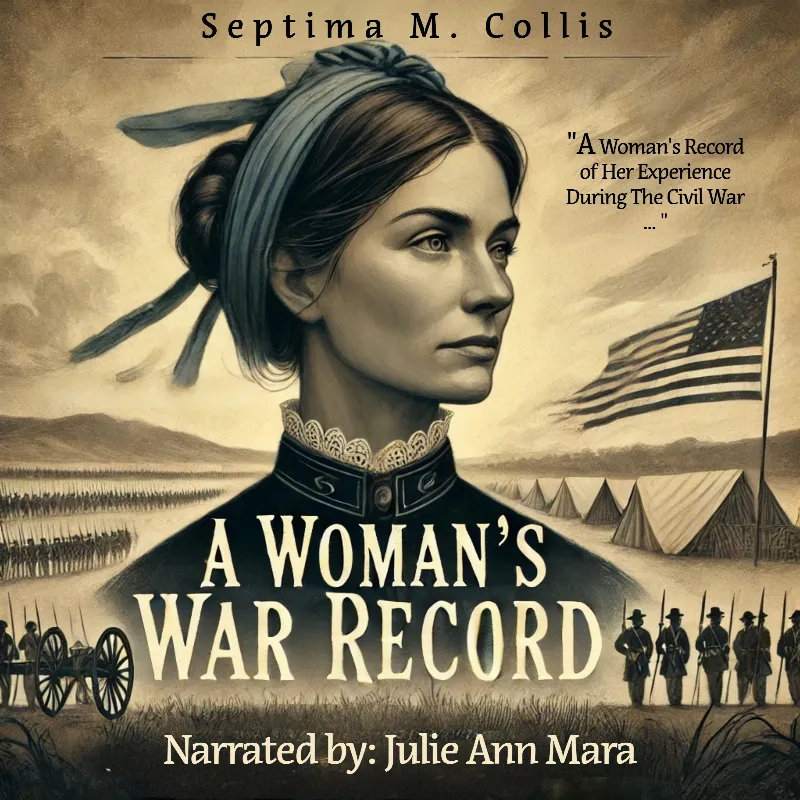
Hear it read by Julie Ann Marra: the audiobook is right here
Story guide on this page: summary, characters, discussion questions
Yours to keep: a DRM-free EPUB for any device. Read it here, or on Kindle (with Send to Kindle), Apple Books, Kobo or Google Play Books.
Want both? Buy the audiobook and add the ebook for $0.99.
Free audiobook
Listen to the whole story free
Enter your email and we'll send you a link to the full audiobook of A Woman's War Record. No account needed.
We'll also ask if you'd like new audiobooks by email. Privacy Policy
✓ DRM-free, yours to keep. Download the files after you buy and play them anywhere.
Yours to keepBuy once, it stays in your library
Listen anywhereIn our app on your phone or computer
Bought by mistake, or something wrong with the file? Email apica@academyvoices.com within 14 days for a full refund.
Bought by mistake or something wrong with the audio? Email apica@academyvoices.com within 14 days for a full refund.
About this audiobookAbout this book
Septima Collis was born in Charleston, South Carolina, in 1842. Her brother fought for the Confederacy. She married a Union officer, Charles Collis, shortly before the Civil War began, and followed him into the field. This is her own account of life in Union army camps, written in 1889.
Her husband captained the Zouaves d'Afrique, and she lived with his company at several points during the war. Along the way she meets President Lincoln and sees a divided country from both sides. Julie Ann Marra reads it in about an hour and a quarter.
For readers who like Civil War history told by someone who was there.
Story guide
A Woman's War Record summary
Spoiler alert: this summary tells the whole story.
Septima Collis was born in Charleston, South Carolina, and her sympathies were with the South, but in December 1861 she married a Northern soldier, Charles H. T. Collis, in Philadelphia. Two days later she joined him in camp at Frederick, Maryland, where his company of "Zouaves d'Afrique" served under General Banks. That first winter is full of dances, parades and a near-drowning when their wagon is swept into the flooded Monocacy River. In the spring the army marches off and the wives are sent home.
Back in Philadelphia, she feels the war for the first time. She hears that her husband's company has been captured, then learns he escaped through the mountains. Her daughter is born in September 1862, but her husband does not see the baby until he is brought home badly ill the next summer. Soon after, her beloved brother David, a Confederate lieutenant, is killed at Murfreesboro, and she says she never truly understood that brother was fighting brother until that moment. On a visit to Washington she has a private talk with President Lincoln, who is lighthearted until he learns that a mother has come to plead for a son who is to be shot the next day.
She travels by cattle car to nurse her husband through pneumonia near Culpeper, lives happily in a pair of army tents in winter camp, and attends a grand corps ball. The winter of 1864 to 1865 she spends at City Point, Virginia, General Grant's headquarters, where General and Mrs. Grant drop in while she and her husband are eating oysters on the floor. On April 2, 1865, she watches the assault on Petersburg from horseback, waits through an anxious night for news, and is nearly hit when her husband's own men fire their muskets into the woods. She is among the first Northern women to ride into Richmond after it falls. Her husband tells how Lincoln warmly greeted a captured Confederate general, Rufus Barringer, whose brother had been his friend in Congress.
On her way home she reaches Baltimore on the day Lincoln is shot, and later watches his funeral procession in Philadelphia. In May she sees the Grand Review of the armies in Washington. She ends by saying that the war strengthened her for the rest of her life and that, as a Southerner, she has come to believe the South also won something in its defeat, because the country remained one people.
This lively, personal memoir gives a rare woman's view of life behind the Union lines, with vivid firsthand glimpses of Lincoln, Grant and Meade.
Famous lines
He is not too young to be killed in the service, and make me a widow.
Septima Collis, to President Lincoln
This poor woman's son is to be shot to-morrow.
Abraham Lincoln
Do you know I have never seen a live rebel general in full uniform.
Abraham Lincoln
We are to-day one people—we might have been a dozen.
Septima Collis, near the end
Main characters
SM
Septima M. CollisThe author, a spirited Charleston-born woman who follows her Union husband to camp throughout the war.
CH
Charles H. T. CollisHer husband, a young Union officer who rises from captain to brigade commander.
AL
Abraham LincolnThe President, whom she meets twice and comes to love and revere.
US
Ulysses S. GrantThe Union general whose headquarters at City Point she lives beside in the war's last winter.
DC
David Cardoza LevyHer brother, a Confederate lieutenant killed at Murfreesboro.
GR
General Rufus BarringerA captured Confederate general whom Lincoln greets with surprising warmth.
Did you know?
The author was born Septima Levy in Charleston, and her brother David fought and died for the Confederacy while her husband fought for the Union.
Her husband, Charles H. T. Collis, was later awarded the Medal of Honor for his bravery at the Battle of Fredericksburg.
She wrote the memoir about twenty-five years after the war, and dedicated it to her mother in July 1889.
Questions to talk about
How does the author's Southern birth shape the way she sees the war and the Confederate prisoners she meets?
Why does she say she did not truly understand the war until she returned to Philadelphia, and then until her brother died?
What do her stories about Lincoln reveal about his character?
Much of the memoir describes balls, meals and fashion. What does that side of camp life add to our picture of the war?
What does she mean when she says there was "victory for the South in the defeat"? Do you agree?
New listeners
Get 25% off your first audiobook
Join our list and we'll email you 25% off, plus new releases from our store. Every one is read by a real person. No account needed.
Details
Length
1 hr 8 min
Narration
Solo narrator
Format
Unabridged audiobook
Publisher
Academy Voices
Language
English
ISBN
9798875189104
Questions
What is A Woman's War Record about?
A Southern-born woman married to a Union officer recalls her four years following the Northern army in the Civil War, from camp balls to the fall of Richmond and a private meeting with Abraham Lincoln.
Who are the main characters in A Woman's War Record?
Septima M. Collis, the author, a spirited Charleston-born woman who follows her Union husband to camp throughout the war; Charles H. T. Collis, her husband, a young Union officer who rises from captain to brigade commander; Abraham Lincoln, the President, whom she meets twice and comes to love and revere; Ulysses S. Grant, the Union general whose headquarters at City Point she lives beside in the war's last winter; David Cardoza Levy, her brother, a Confederate lieutenant killed at Murfreesboro; General Rufus Barringer, a captured Confederate general whom Lincoln greets with surprising warmth.
Who narrates the A Woman's War Record audiobook?
This edition of A Woman's War Record by Septima M. Collis is narrated by Julie Ann Marra.
How long is the A Woman's War Record audiobook?
It runs 1 hr 8 min, unabridged, so you hear the complete text.
Is this audiobook narrated by a real person?
Yes. Every Academy Voices audiobook is Certified Human Voice: performed start to finish by a real narrator.
Where can I listen to A Woman's War Record?
Right here: buy it on Academy Voices and listen in your browser or our app. Hear a free sample on this page first.