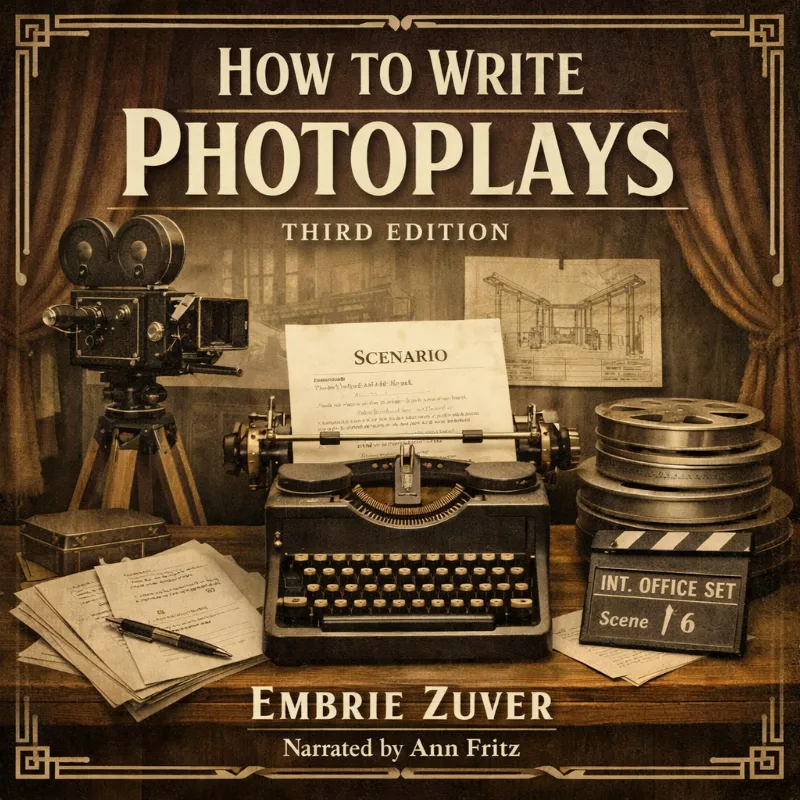
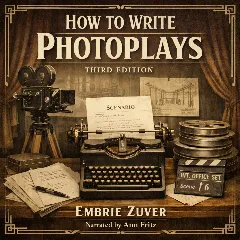
A guide for people who want to write for the movies in the silent film era. Embrie Zuver explains the terms of the trade: close-ups, subtitles, inserts and cut-backs.
Hear it read by Ann Fritz: the audiobook is right here
Story guide on this page: summary, characters, discussion questions
Yours to keep: a DRM-free EPUB for any device. Read it here, or on Kindle (with Send to Kindle), Apple Books, Kobo or Google Play Books.
Want both? Buy the audiobook and add the ebook for $0.99.
Free audiobook
Listen to the whole story free
Enter your email and we'll send you a link to the full audiobook of How to Write Photoplays. No account needed.
We'll also ask if you'd like new audiobooks by email. Privacy Policy
✓ DRM-free, yours to keep. Download the files after you buy and play them anywhere.
Yours to keepBuy once, it stays in your library
Listen anywhereIn our app on your phone or computer
Bought by mistake, or something wrong with the file? Email apica@academyvoices.com within 14 days for a full refund.
Bought by mistake or something wrong with the audio? Email apica@academyvoices.com within 14 days for a full refund.
About this audiobookAbout this book
A guide for people who want to write for the movies in the silent film era. Embrie Zuver explains the terms of the trade: close-ups, subtitles, inserts and cut-backs. The book shows how to turn an idea into a plot, how long a reel runs, how to write a synopsis and a scenario, and how to prepare and send a manuscript. It also covers the market, typical payments, copyright and censorship.
Published in 1915, it shows how an early film industry looked for stories. Ann Fritz reads it in an hour and twenty-three minutes.
For film history fans and screenwriters.
Story guide
How to Write Photoplays summary
Spoiler alert: this summary tells the whole story.
Embrie Zuver promises a guide with no padding, just what a beginner needs to write a photoplay, as silent-film scripts were then called. The first lesson is a glossary of studio terms: close-up, cut back, leader, insert, "register" (to show a feeling clearly on screen) and reel, a thousand feet of film that runs about twenty minutes.
Short lessons follow on finding an original idea, building a plot toward a strong climax, timing a one-reel or two-reel picture, writing a catchy title and a synopsis of no more than 250 words a reel, choosing a small cast and laying out numbered scenes. Zuver stresses that the camera must tell the story through action, that subtitles should be few and short, and that scenes should be cheap and practical to film. Comedies, he notes, are in the greatest demand.
The later lessons cover the business side. Scripts must be typed, double-spaced and mailed flat with a return envelope, marked "Submitted at usual rates." Twenty-five dollars is a good price for a short play. The book describes the Board of Censors and ends with a list of don'ts: no plagiarism, no costly train wrecks or sinking ships, no murders, suicides or graveyards, and nothing that mocks a religion or nationality.
The book closes with a full sample script, Timid Teddy. Shy young millionaire Teddy Tyler cannot bring himself to propose to Martha Stone, so his chum Harry Jackson gets him drunk. At a dance Teddy proposes to the wrong two women, who both accept. To escape, he plants a newspaper story that he has lost his fortune. Both women break it off at once, while Martha comes to offer him a loan, and Teddy finally finds the courage to propose to her.
The book is a small window onto the early movie business, when studios bought story ideas from ordinary people through the mail and screenwriting was still being invented.
Famous lines
Photoplays are, of course, dumb, and their meaning must be clearly expressed by action.
Lesson VI
Comedy plays are in the greatest demand.
Lesson III
Twenty-five dollars is a good average for a short play.
Lesson XXII
Main characters
EZ
Embrie ZuverThe author, who ran a New York scenario-writing business and wrote this guide.
TT
Teddy TylerThe timid young millionaire hero of the sample script.
HJ
Harry JacksonTeddy's chum, whose bright ideas cause most of the trouble.
MS
Martha StoneThe kind young woman Teddy really loves.
EH
Edith Harcourt and Janice RansomThe two women Teddy proposes to by mistake.
Did you know?
"Photoplay" was a common word in the 1910s for a motion picture or its script.
In silent films a "subtitle" meant a title card of words shown between scenes, not text along the bottom of the screen.
The censorship board Zuver describes was set up in New York in 1909 and later became the National Board of Review.
Questions to talk about
Which of Zuver's rules still apply to screenwriters today, and which seem out of date?
Why do you think comedies sold for the most money in 1915?
Zuver tells writers to avoid expensive scenes like train wrecks. How has that changed in modern movies?
Read the Timid Teddy synopsis. How would you rewrite the story as a modern film?
What does the list of don'ts tell you about what audiences and censors of 1915 found acceptable?
Chapters
How to Write Photoplays chapters
ChapterStarts at
Introductory0:21
Lesson 11:29
Lesson 210:58
Lesson 312:33
Lesson 415:23
Lesson 517:04
Lesson 619:13
Lesson 722:55
Lesson 823:26
Lesson 924:56
Show all 28 chapters
Lesson 1026:45
Lesson 1128:58
Lesson 1230:45
Lesson 1331:24
Lesson 1434:17
Lesson 1535:02
Lesson 1635:36
Lesson 1736:58
Lesson 1838:34
Lesson 1940:17
Lesson 2041:35
Lesson 2142:58
Lesson 2247:06
Lesson 2347:45
Lesson 2448:22
Lesson 2549:14
Lesson 2651:07
Lesson 2755:00
New listeners
Get 25% off your first audiobook
Join our list and we'll email you 25% off, plus new releases from our store. Every one is read by a real person. No account needed.
Details
Length
1 hr 23 min
Narration
Solo narrator
Format
Unabridged audiobook
Publisher
Academy Voices
Language
English
ISBN
9798295385346
Questions
What is How to Write Photoplays about?
A handbook from the silent-film era that teaches would-be screenwriters how to turn an idea into a "photoplay" a studio might buy, complete with a sample comedy script called Timid Teddy.
Who are the main characters in How to Write Photoplays?
Embrie Zuver, the author, who ran a New York scenario-writing business and wrote this guide; Teddy Tyler, the timid young millionaire hero of the sample script; Harry Jackson, teddy's chum, whose bright ideas cause most of the trouble; Martha Stone, the kind young woman Teddy really loves; Edith Harcourt and Janice Ransom, the two women Teddy proposes to by mistake.
Who narrates the How to Write Photoplays audiobook?
This edition of How to Write Photoplays by Embrie Zuver is narrated by Ann Fritz.
How long is the How to Write Photoplays audiobook?
It runs 1 hr 23 min, unabridged, so you hear the complete text.
Is this audiobook narrated by a real person?
Yes. Every Academy Voices audiobook is Certified Human Voice: performed start to finish by a real narrator.
Where can I listen to How to Write Photoplays?
Right here: buy it on Academy Voices and listen in your browser or our app. Hear a free sample on this page first.