Hear it read by Gary Middleton: the audiobook is right here
Story guide on this page: summary, characters, discussion questions
Yours to keep: a DRM-free EPUB for any device. Read it here, or on Kindle (with Send to Kindle), Apple Books, Kobo or Google Play Books.
Want both? Buy the audiobook and add the ebook for $0.99.
✓ DRM-free, yours to keep. Download the files after you buy and play them anywhere.
Yours to keepBuy once, it stays in your library
Listen anywhereIn our app on your phone or computer
Bought by mistake, or something wrong with the file? Email apica@academyvoices.com within 14 days for a full refund.
Bought by mistake or something wrong with the audio? Email apica@academyvoices.com within 14 days for a full refund.
About this audiobookAbout this book
Meditations is the private notebook of Marcus Aurelius, Roman emperor and Stoic philosopher. He wrote it to himself, often while on campaign, as a way to stay calm, fair and clear-headed: accept what you cannot control, do your duty, treat others well, and remember that life is short.
There is no plot, just short, direct thoughts you can take in any order. Read by Gary Middleton.
A good companion for anyone looking for steadiness in a hard season, from a man who ruled an empire and still had to remind himself how to live.
Story guide
Meditations summary
Spoiler alert: this summary tells the whole story.
Marcus Aurelius ruled the Roman Empire from AD 161 to 180, and he spent many of those years at war on the Danube frontier. In his spare moments he wrote notes to himself in Greek. He never meant them for anyone else. They were later gathered into twelve books, now called the Meditations. He was a follower of Stoicism, a philosophy that teaches people to live by reason and accept what they cannot control.
The first book is a list of thanks. Marcus names what he learned from each person who shaped him: good morals and an even temper from his grandfather, modesty from the memory of his father, generosity and simple living from his mother, and patience, fairness and hard work from his adoptive father, the emperor Antoninus Pius. His teacher Rusticus introduced him to the writings of the Stoic philosopher Epictetus.
The remaining books return again and again to a handful of ideas. Each morning, he tells himself, he will meet rude, ungrateful and dishonest people, but they act from ignorance, and he must not be angry, since all people are made to work together like hands or feet. Our troubles come not from events but from our opinions about them, and those opinions are in our own power. Fame is empty, since everyone who praises us will soon be forgotten too.
Marcus reminds himself often that life is short and that everything changes. Empires, cities and great men pass away. Death is natural and nothing to fear. What matters is to do the work in front of you well, to act justly, to tell the truth and to serve the common good, without waiting for thanks.
The Meditations has comforted and guided readers for nearly two thousand years. It is a rare chance to hear one of the most powerful men in history reasoning with himself about how to be good.
Famous lines
Begin the morning by saying to thyself, I shall meet with the busybody, the ungrateful, arrogant, deceitful, envious, unsocial.
Book II
Take away thy opinion, and then there is taken away the complaint, "I have been harmed." Take away the complaint, "I have been harmed," and the harm is taken away.
Book IV
Do not act as if thou wert going to live ten thousand years. Death hangs over thee. While thou livest, while it is in thy power, be good.
Book IV
That which is not good for the swarm, neither is it good for the bee.
Book VI
Main characters
MA
Marcus AureliusThe Roman emperor and Stoic philosopher who wrote the notes to himself.
AP
Antoninus PiusHis adoptive father and the emperor before him, praised as a model of patience and justice.
R
RusticusA teacher who showed Marcus the value of discipline and introduced him to Epictetus.
E
EpictetusA Stoic philosopher, once enslaved, whose teachings deeply influenced Marcus.
Did you know?
Marcus wrote in Greek, not Latin, the usual language of philosophy in his day.
He never gave the work a title. The Greek heading found in manuscripts means roughly "to himself."
Part of the first book ends with a note that it was written "Among the Quadi at the Granua," a military camp on the frontier.
Questions to talk about
Marcus says our opinions, not events, cause our troubles. Do you agree? Give an example.
Why would the most powerful man in the world need to remind himself to be humble?
What does Marcus learn from the people he thanks in Book I? Who would be on your own list?
How does thinking about death help Marcus live better?
Which of his ideas would be easiest to practice today, and which would be hardest?
Chapters
Meditations chapters
ChapterStarts at
Introduction0:21
His First Book36:14
The Second Book1:06:02
The Third Book1:22:26
The Fourth Book1:47:37
The Fifth Book2:28:49
The Sixth Book3:08:06
The Seventh Book3:50:08
The Eighth Book4:35:13
The Ninth Book5:20:11
Show all 13 chapters
The Tenth Book6:01:04
The Eleventh Book6:46:16
The Twelfth Book7:19:31
New listeners
Get 25% off your first audiobook
Join our list and we'll email you 25% off, plus new releases from our store. Every one is read by a real person. No account needed.
Details
Length
7 hr 47 min
Narration
Solo narrator
Format
Unabridged audiobook
Publisher
Academy Voices
Language
English
ISBN
9798295346934
Cover art
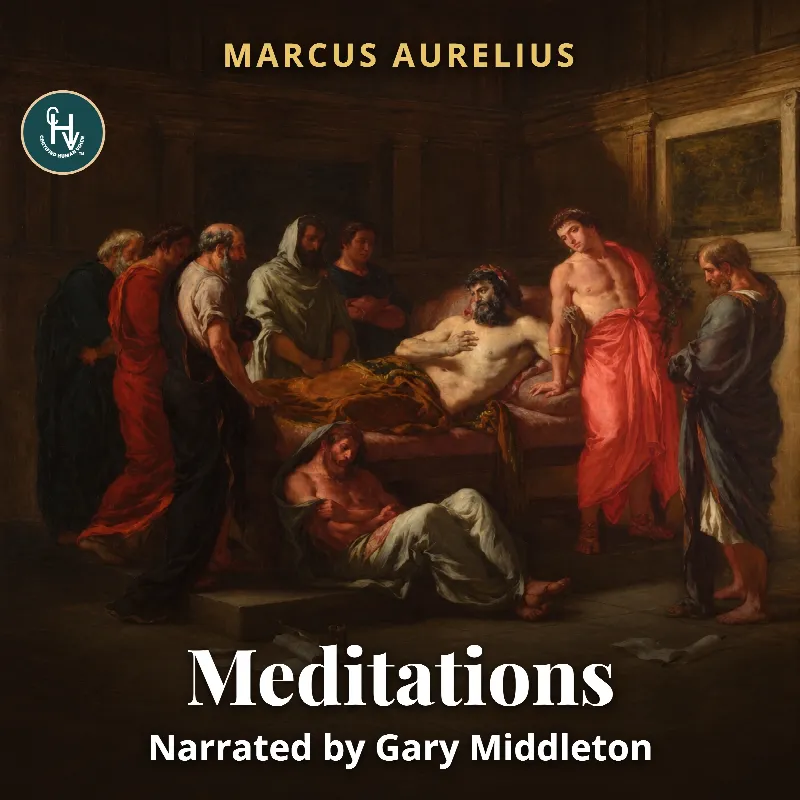
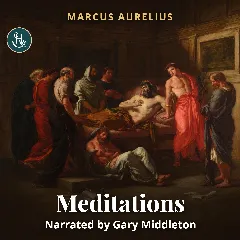
Eugène Delacroix, The Last Words of the Emperor Marcus Aurelius (1844)
Questions
What is Meditations about?
The private notebook of the Roman emperor Marcus Aurelius, full of reminders to himself about living with reason, self-control and kindness in a short and changing life.
Who are the main characters in Meditations?
Marcus Aurelius, the Roman emperor and Stoic philosopher who wrote the notes to himself; Antoninus Pius, his adoptive father and the emperor before him, praised as a model of patience and justice; Rusticus, a teacher who showed Marcus the value of discipline and introduced him to Epictetus; Epictetus, a Stoic philosopher, once enslaved, whose teachings deeply influenced Marcus.
Who narrates the Meditations audiobook?
This edition of Meditations by Marcus Aurelius is narrated by Gary Middleton.
How long is the Meditations audiobook?
It runs 7 hr 47 min, unabridged, so you hear the complete text.
Is this audiobook narrated by a real person?
Yes. Every Academy Voices audiobook is Certified Human Voice: performed start to finish by a real narrator.
Where can I listen to Meditations?
Right here: buy it on Academy Voices and listen in your browser or our app. Hear a free sample on this page first.