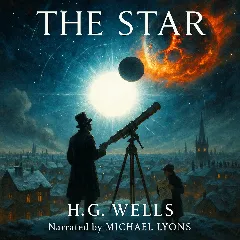
Hear it read by Michael Lyons: the audiobook is right here
Story guide on this page: summary, characters, discussion questions
Yours to keep: a DRM-free EPUB for any device. Read it here, or on Kindle (with Send to Kindle), Apple Books, Kobo or Google Play Books.
Want both? Buy the audiobook and add the ebook for $0.99.
Free audiobook
Listen to the whole story free
Enter your email and we'll send you a link to the full audiobook of The Star. No account needed.
We'll also ask if you'd like new audiobooks by email. Privacy Policy
✓ DRM-free, yours to keep. Download the files after you buy and play them anywhere.
Yours to keepBuy once, it stays in your library
Listen anywhereIn our app on your phone or computer
Bought by mistake, or something wrong with the file? Email apica@academyvoices.com within 14 days for a full refund.
Bought by mistake or something wrong with the audio? Email apica@academyvoices.com within 14 days for a full refund.
About this audiobookAbout this book
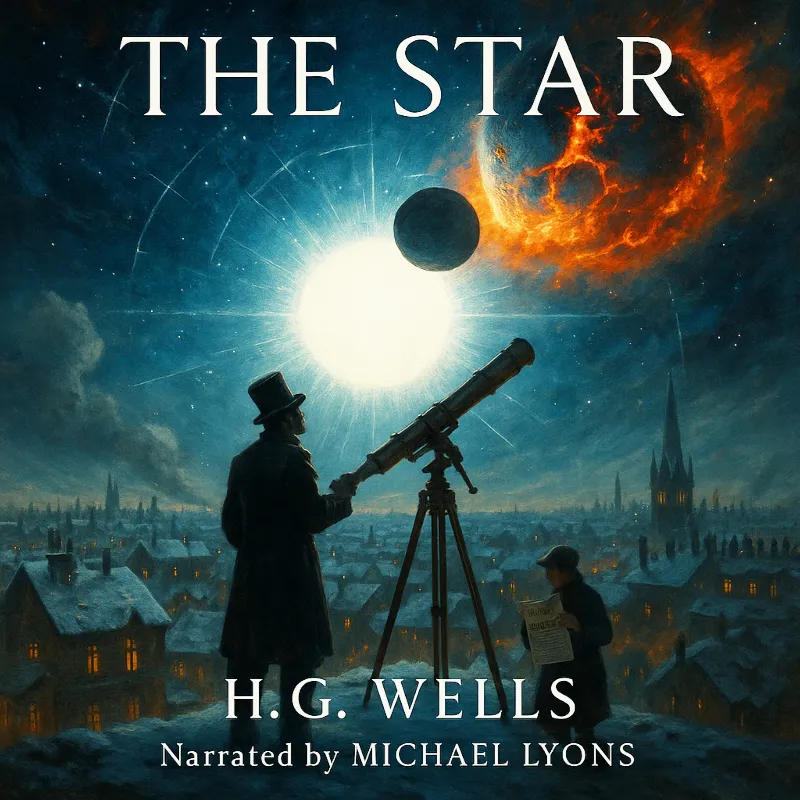
A new star appears and heads toward the sun. Astronomers watch it hit Neptune. Then it comes on toward the sun, and the Earth begins to feel its pull. The heat rises. People wait for what comes next.
H. G. Wells's story of a collision and of how people take the end of the world, read by Michael Lyons. Twenty-nine minutes.
For readers who like Wells at his most dramatic.
Story guide
The Star summary
Spoiler alert: this summary tells the whole story.
On New Year's Day, astronomers announce that the planet Neptune is moving strangely. A faint speck of light near it grows larger and brighter, a huge body rushing in from outer space. Within days it crashes into Neptune, and the two worlds fuse into one glowing mass. The next dawn, people all over the world see a great white star in the sky, brighter than any other. Each night it rises larger. In the observatories, the watchers whisper, "It is nearer," and the words race around the globe.
People react in every way. A tramp hopes it will bring some warmth, a grieving woman cares nothing for it, a schoolboy works out the physics, and two lovers in Africa call it their star. A master mathematician, after four sleepless nights of calculation, calmly tells his students that "man has lived in vain." The burning star is falling toward the sun, but its path will take it near the giant planet Jupiter, which will swing it toward Earth. His warning is telegraphed around the world. Bells ring, churches fill, and ships put out to sea, yet most people carry on as usual, and newspapers mock the fear. When the star rises one night no bigger than before, many laugh at the danger.
Then the star grows steadily, turning night into day. Over five days it sweeps past Earth. The heat melts snow and ice, rivers flood their valleys, huge tides drown coastal cities, volcanoes erupt across Asia, and earthquakes shake the Americas. The plains of India become a sea, with people clinging to temples and rooftops. At last the moon passes in front of the star and gives a moment of relief. Star, sun and moon race across the sky together, and then the star moves on, falling into the sun.
Terrible rains and darkness follow, and earthquakes go on for months. Survivors creep back to their ruined cities. The world is changed: the days are hotter, the moon looks only a third of its old size and takes eighty days to go from new moon to new moon, and in time Greenland and the shores of Baffin Bay grow green as people move toward the poles. The story ends with astronomers on Mars, who observe calmly that Earth suffered surprisingly little damage. Wells adds that this only shows how small the greatest human disaster can seem from millions of miles away.
H. G. Wells's short story is an early classic of the disaster tale. It is admired for its sweeping, almost cinematic view of the whole world reacting to one approaching danger, and for its humbling ending.
Famous lines
"It is nearer," they said. "Nearer!"
The watchers in the observatories
"You may kill me," he said after a silence, "But I can hold you—and all the universe for that matter—in the grip of this little brain. I would not change even now."
The master mathematician
It would seem, gentlemen, if I may put the thing clearly and briefly, that—man has lived in vain.
The master mathematician
Which only shows how small the vastest of human catastrophies may seem at a distance of a few million miles.
The closing line
Main characters
MM
The master mathematicianA calm, brilliant professor who calculates that the star will pass close to Earth.
S
The studentsYoung people who at first think their professor is mad, then begin to understand.
OD
Ogilvy and DuchineAstronomers who first notice the danger in the sky.
PW
The people of the worldCrowds, tramps, lovers, priests and sailors, who each react to the star in their own way.
MA
The Martian astronomersObservers on Mars who calmly study the disaster from far away.
Did you know?
Wells later included "The Star" in his story collection Tales of Space and Time, published in 1899.
This version of the story was reprinted in Amazing Stories, one of the first magazines devoted to science fiction, in June 1926.
An astronomer named Ogilvy also appears in Wells's novel The War of the Worlds.
Questions to talk about
Why do you think Wells shows us so many different people, from a tramp to a schoolboy, instead of following one hero?
The mathematician says, "man has lived in vain," yet much of humanity survives. Was he wrong?
Why do so many people laugh at the warnings even as the star grows brighter? Does this happen today?
How does the ending with the Martian astronomers change the way you see everything that came before?
The story briefly mentions "the new brotherhood that grew presently among men." What do you think that would look like?
New listeners
Get 25% off your first audiobook
Join our list and we'll email you 25% off, plus new releases from our store. Every one is read by a real person. No account needed.
Details
Length
29 min
Narration
Solo narrator
Format
Unabridged audiobook
Publisher
Academy Voices
Language
English
ISBN
9798347387397
Questions
What is The Star about?
A huge wandering body from outer space smashes into Neptune and the blazing mass hurtles toward the sun, passing so close to Earth that floods, earthquakes and terrible heat sweep the planet.
Who are the main characters in The Star?
The master mathematician, a calm, brilliant professor who calculates that the star will pass close to Earth; The students, young people who at first think their professor is mad, then begin to understand; Ogilvy and Duchine, astronomers who first notice the danger in the sky; The people of the world, crowds, tramps, lovers, priests and sailors, who each react to the star in their own way; The Martian astronomers, observers on Mars who calmly study the disaster from far away.
Who narrates The Star audiobook?
This edition of The Star by H. G. Wells is narrated by Michael Lyons.
How long is The Star audiobook?
It runs 29 min, unabridged, so you hear the complete text.
Is this audiobook narrated by a real person?
Yes. Every Academy Voices audiobook is Certified Human Voice: performed start to finish by a real narrator.
Where can I listen to The Star?
Right here: buy it on Academy Voices and listen in your browser or our app. Hear a free sample on this page first.