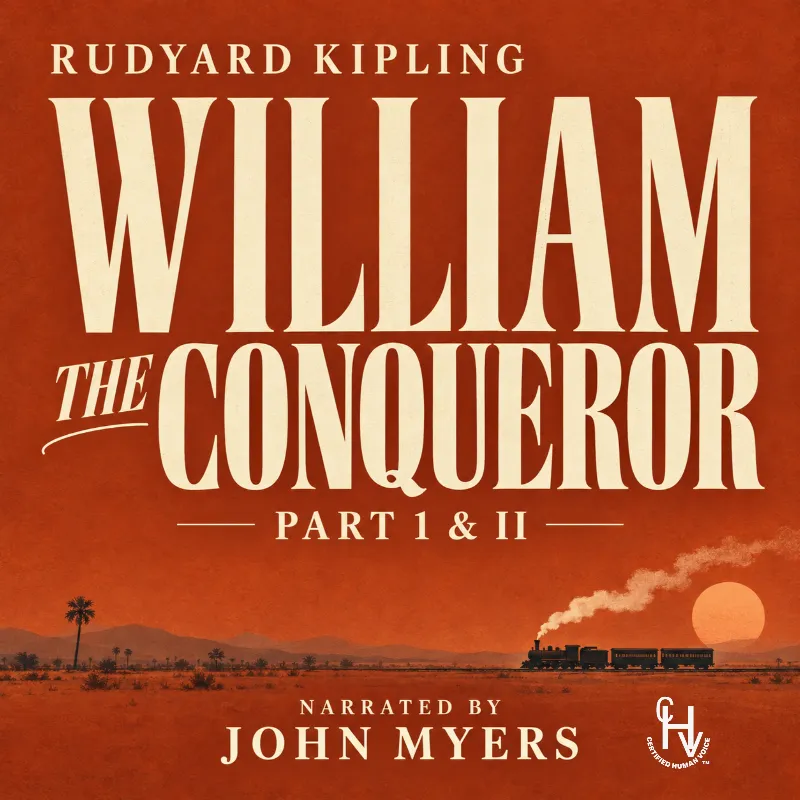
Rudyard Kipling’s taut, tender two-part tale unfolds amid a searing South Indian famine. Wilhelmina “William” Martyn—a fearless, whip-smart Englishwoman—refuses the safety of the hills and rides straight into the crisis.
Hear it read by John Myers: the audiobook is right here
Story guide on this page: summary, characters, discussion questions
Yours to keep: a DRM-free EPUB for any device. Read it here, or on Kindle (with Send to Kindle), Apple Books, Kobo or Google Play Books.
Want both? Buy the audiobook and add the ebook for $0.99.
Free audiobook
Listen to the whole story free
Enter your email and we'll send you a link to the full audiobook of William the Conqueror, Parts I & II. No account needed.
We'll also ask if you'd like new audiobooks by email. Privacy Policy
✓ DRM-free, yours to keep. Download the files after you buy and play them anywhere.
Yours to keepBuy once, it stays in your library
Listen anywhereIn our app on your phone or computer
Bought by mistake, or something wrong with the file? Email apica@academyvoices.com within 14 days for a full refund.
Bought by mistake or something wrong with the audio? Email apica@academyvoices.com within 14 days for a full refund.
About this audiobookAbout this book
Rudyard Kipling’s taut, tender two-part tale unfolds amid a searing South Indian famine. Wilhelmina “William” Martyn—a fearless, whip-smart Englishwoman—refuses the safety of the hills and rides straight into the crisis. Beside her works Scott, a driven irrigation engineer seconded to famine duty, hauling grain, building sheds, and, in one unforgettable turn, saving starving infants with a flock of milk goats.
As trains blaze through the night and convoys grind across dust and flood, duty, grit, and compassion forge a bond that neither distance nor danger can break. Kipling’s eye for the rhythms of work and the textures of camp life—cart wheels, cracked earth, monsoon rain, and the hum of a makeshift hospital—meets a slow-burn romance between equals: a heroine nicknamed “William” who looks the world in the eye, and the man who matches her courage.
Brought to life in a clear, character-rich performance by John Myers, this classic offers both high-stakes adventure and a deeply human love story. Perfect for fans of literary historical fiction, British India settings, and love-under-fire narratives.
Story guide
William the Conqueror, Parts I & II summary
Spoiler alert: this summary tells the whole story.
On a stifling evening in the Punjab, news comes that famine has been declared in eight districts of Madras, far to the south, and Sir James "Jimmy" Hawkins, Head of the Famine, is calling for good men. Scott, a quiet, capable irrigation engineer, and Jack Martyn, a police officer, are both ordered south. Martyn's sister, known to everyone as William, insists on coming too. She is a short-haired, plain-spoken young woman who rides, speaks Urdu and Punjabi, has survived cholera and typhoid, and has turned down every man who proposed to her. After a week on crowded, stifling trains through a land of dying people, they arrive at Hawkins's camp.
Hawkins sends Martyn to run grain trains and sends Scott south with a convoy of bullock carts full of wheat and millet. William stays at the camp with Mrs. Jim Hawkins to care for starving babies. Scott discovers that the southern people eat rice and do not know what to do with northern grains. Many refuse them and die. So, with his servant Faiz Ullah, Scott rounds up stray goats, feeds them the unwanted grain and milks them to keep dying babies alive. He returns to camp walking at the head of his flock of goats and children, and William, watching him come through the golden dust of sunset, sees him with new eyes.
At dawn William helps him with the milking, and something unspoken passes between them. A small boy announces that William must be "our man's woman," to everyone's laughter. Scott is nicknamed Bakri Scott, "Goat Scott," which William fiercely resents. He is sent off for weeks of punishing work in another district. Though he passes within five miles of the camp, he does not ride in, because his work comes first. William knew he would not, and rode out secretly just to glimpse him passing.
When the rains come, Scott collapses with fever after reporting his district safe, and Faiz Ullah nurses him through it. Back at camp, he and William finally speak, and she admits she understood why he stayed away and that she cared. They become engaged, to the delight of Mrs. Jim. The story ends in the crisp cold of the northern December, at the Christmas Ball, as carolers sing "While Shepherds Watched" and William wipes her eyes.
This is one of Kipling's warmest stories, a love story told through hard work and duty rather than romance. William is one of his most memorable heroines, and the story honors the people who fought India's famines.
Famous lines
I like men who do things
William
Give the women something to live for,” said Scott to himself, as he sneezed in the dust of a hundred little feet, “and they’ll hang on somehow.
Scott
Being engaged is abominable, because, you see, one has no official position.
William
This time it was William that wiped her eyes.
The closing line
Main characters
W
William (Miss Martyn)A brave, capable, boyish young Englishwoman who nurses famine babies.
S
ScottA quiet, tireless irrigation engineer who saves babies with goat's milk.
JM
Jack MartynWilliam's brother, a police officer sent to run famine trains.
SJ
Sir James "Jimmy" HawkinsThe shrewd, hard-driving Head of the Famine.
J
Mrs. Jim (Lizzie Hawkins)His kind wife, who looks after William and watches the romance with delight.
FU
Faiz UllahScott's proud, loyal servant, who nurses him through fever.
Did you know?
Kipling based the famine on the real famines that struck southern India in the 1870s and 1890s, when British officials and volunteers ran relief camps.
Each part of the story opens with a few lines from a poem by John Donne.
"Bakri," Scott's nickname, means "goat" in the northern Indian language the characters speak.
Questions to talk about
Why does William insist on going to the famine, and what does that tell you about her?
How does Scott solve the problem of the babies, and what does his solution show about him?
Why doesn't Scott ride into camp when he passes so close? Why does William respect him more for it?
Why does William get so angry about the nickname "Bakri Scott"?
How does Kipling show love without the characters ever saying "I love you"?
Chapters
William the Conqueror, Parts I & II chapters
ChapterStarts at
Part 10:21
Part 230:05
New listeners
Get 25% off your first audiobook
Join our list and we'll email you 25% off, plus new releases from our store. Every one is read by a real person. No account needed.
Details
Length
1 hr 10 min
Narration
Solo narrator
Format
Unabridged audiobook
Publisher
Anthony Pica Productions LLC
Language
English
ISBN
9798182661546
Questions
What is William the Conqueror, Parts I & II about?
During a terrible famine in southern India, a hardworking canal engineer and a fearless young Englishwoman called William fall quietly in love while saving starving people and babies.
Who are the main characters in William the Conqueror, Parts I & II?
William (Miss Martyn), a brave, capable, boyish young Englishwoman who nurses famine babies; Scott, a quiet, tireless irrigation engineer who saves babies with goat's milk; Jack Martyn, william's brother, a police officer sent to run famine trains; Sir James "Jimmy" Hawkins, the shrewd, hard-driving Head of the Famine; Mrs. Jim (Lizzie Hawkins), his kind wife, who looks after William and watches the romance with delight; Faiz Ullah, scott's proud, loyal servant, who nurses him through fever.
Who narrates the William the Conqueror, Parts I & II audiobook?
This edition of William the Conqueror, Parts I & II by Rudyard Kipling is narrated by John Myers.
How long is the William the Conqueror, Parts I & II audiobook?
It runs 1 hr 10 min, unabridged, so you hear the complete text.
Is this audiobook narrated by a real person?
Yes. Every Academy Voices audiobook is Certified Human Voice: performed start to finish by a real narrator.
Where can I listen to William the Conqueror, Parts I & II?
Right here: buy it on Academy Voices and listen in your browser or our app. Hear a free sample on this page first.