Is This Audiobook Narrated by a Real Person? How to Tell
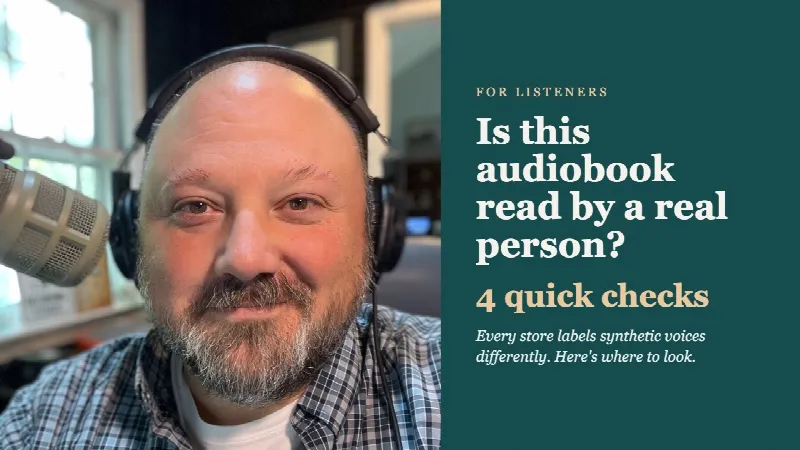
To tell if an audiobook is narrated by a real person, look at the narrator's name on the store page. Synthetic narration is labeled: Audible says "Virtual Voice," Apple says "an Apple Books digital voice," and Google Play marks it "Auto-narrated." Then play the sample and listen for breath, character voices and natural pacing.
Synthetic narration has grown fast. Audible alone now carries tens of thousands of Virtual Voice titles, and Apple, Google Play and Spotify all sell digitally narrated audiobooks. Most stores label them, but the labels look different everywhere and they are easy to miss. Here is where to look on each store, what the labels say, and how to check the ones that slip through.
How each store labels synthetic narration
| Store | What the label says | Where you'll see it |
|---|---|---|
| Audible and Amazon | Virtual Voice | The narrator field on the product page |
| Apple Books | Narrated by [name], an Apple Books digital voice | Next to the narrator's name; the description starts with a note too |
| Google Play Books | Auto-narrated | On the listing, with the name of the voice used |
| Spotify and stores supplied by INaudio | A note saying the book was made with digital voice narration | In the book's description |
| Libro.fm | Labels on product pages and in the app | Next to the narrator; Libro.fm won't promote synthetic titles |
Labels checked October 2026. Stores change their wording, so if a label looks different, check the narrator's name.
Apple's own publisher guidelines require digitally narrated titles to open their description with "This is an Apple Books audiobook narrated by a digital voice based on a human narrator," according to Apple's partner help page. INaudio, which supplies Spotify and many other stores, says on its support site that it adds a disclosure to the description of every digitally narrated title automatically.
Step 1: Look at the narrator's name
This is the fastest check and it catches most cases. On any store page, find the line that says "Narrated by." A real narrator is a person with a name you can click. Their page usually lists other audiobooks, and many have their own website or a profile on a casting site.
A synthetic voice shows a store label instead, or a first name with a note after it, like "Madison, an Apple Books digital voice." If the narrator field is empty, or the same unfamiliar name appears on thousands of unrelated books in a single year, be suspicious and move to the next step.
Step 2: Play the sample
Every major store lets you play a few minutes before you buy. Use it. You don't need a trained ear to hear the difference, just a few things to listen for.
Breath and pauses
A person has to breathe, and good narrators use the breath. They pause before a reveal, speed up in an argument, and slow down when a character is thinking. Synthetic voices tend to keep an even rhythm from sentence to sentence, with pauses that land in the same place every time.
Character voices
Listen to a stretch of dialogue. A human narrator gives each character something of their own: a pitch, an accent, an attitude. Synthetic narration often reads every character in the same voice, or changes voice in ways that don't fit who is speaking.
Names and odd words
Made-up names, foreign words and words with two pronunciations, like "read" or "lead," are where synthetic voices slip. A narrator researches these before recording. Listen for a name said two different ways, or stress on the wrong syllable.
Emotion that matches the scene
This is the big one. A real performance changes when the story does. A funeral and a joke sound different. If a tense scene sounds exactly as calm as the opening paragraph, you are probably not hearing a person.
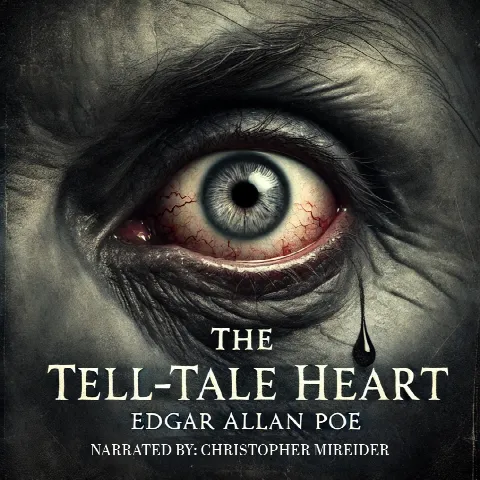
Here is what a human performance sounds like. Christopher Mireider reads Poe's The Tell-Tale Heart, a story that only works if the narrator's voice tightens as the heartbeat gets louder.
Step 3: Check the publisher
Scroll to the publisher line on the store page. Some publishers state their policy openly. Libro.fm, the audiobook store that supports independent bookshops, has said in a public policy update that it will never knowingly promote synthetic titles, and it refunds listeners who buy one by mistake. Some publishers, including us, guarantee that every title is performed by a person.
At Academy Voices, every audiobook carries our Certified Human Voice promise: a real narrator, speaking in their own voice, with their consent. It is written into every narrator's agreement. Every title in our catalog names its narrator, and every one has a free sample, so you can hear the person before you buy.
Step 4: Search more carefully on Audible
On Audible, Virtual Voice titles show up in search alongside everything else. Some listeners filter them out by adding "&narrator=-virtual" to the end of an Audible search address, a trick described by Foliovision. It is not an official Audible feature, so it may stop working, but it is worth a try if you browse a lot.
What the labels don't tell you
A label tells you who, or what, is reading. It doesn't tell you everything. A synthetic voice can be built from many anonymous speakers, or licensed from one real narrator as a copy of their voice. The Audio Publishers Association's naming guidelines from October 2024 ask publishers to label both kinds, and to label a title once more than 10% of a voice is synthetic. Those are recommendations, though, and not every store shows them the same way.
Labels also depend on the publisher telling the truth. Stores can't reliably detect an unlabeled synthetic voice on their own, which is why the sample and the narrator's name matter so much.
What to do if you think a book is mislabeled
Sometimes a title sounds synthetic but carries a human name, or no label at all. If that happens, don't just leave a one-star review. Tell the store, because labels only work when someone reports the ones that are wrong.
Most stores have a "report a problem" or "contact us" link on the product page. Say which book it is, what you heard, and roughly where in the sample. Libro.fm asks listeners to email hello@libro.fm, and says it will look into every report. If you bought the book, ask for a refund at the same time, and say plainly why you are returning it.
It also helps to check the narrator's name outside the store. Search it on its own. A working narrator usually turns up quickly, on a casting site, a personal website, social media, or other audiobook listings. If the name leads nowhere at all, that is worth mentioning in your report.
A 60-second checklist before you buy
Run through these five checks on any audiobook you're not sure about. Most of the time you will have your answer after the first one.
1. Read the narrator line. A store label like "Virtual Voice" or "digital voice" answers the question straight away.
2. Click the narrator's name. A person usually has other books, a photo, and a history.
3. Read the first lines of the description. Some stores put their disclosure there.
4. Play the sample, and skip ahead to dialogue. Listen for breath, pace and different voices for different characters.
5. Check the publisher. Look for a stated policy on human narration, like our Certified Human Voice promise.
None of this takes long. After a few books, you'll hear the difference in the first thirty seconds, the same way you can tell a live band from a recording.
Why it matters
Synthetic narration has real uses. It can make a book available in audio that would never have had a narrator at all, and some listeners don't mind it for straightforward nonfiction. The problem is not that it exists. The problem is not knowing which one you are paying for.
A human narrator makes hundreds of small choices in every chapter: where to pause, how a character sounds when they lie, when to let a line land. That is a performance, and it is why fiction especially sounds different read by a person. When you choose a human-narrated audiobook, you are also paying a working narrator for that performance. Many of the narrators in our catalog are independent voice actors who record from home studios, and every sale and library loan pays them a share.
Questions listeners ask
Does Audible label synthetic narration?
Yes. Titles made with Amazon's own voice program show "Virtual Voice" in the narrator field on the product page.
Can I get a refund if I bought a synthetic audiobook by mistake?
It depends on the store. Libro.fm says it refunds those purchases. On other stores, use their normal return policy and say why you are returning it.
Are all Academy Voices audiobooks narrated by real people?
Yes, every one. That is our Certified Human Voice promise, and each title names the narrator who performed it.
Is a narrator's "voice replica" the same as the narrator?
No. A replica is a synthetic copy of a real narrator's voice, used with their permission. It sounds like them, but they did not perform the book. Good stores label it separately from the narrator's own recordings.
Why do some synthetic audiobooks sound so convincing?
Short samples hide the weak spots. Listen to dialogue and emotional scenes, not just the opening narration, and the difference usually shows within a minute or two.
Hear the difference for yourself
The easiest way to train your ear is to listen. Browse our catalog and press play on any title, or start with our classic horror audiobooks for Halloween. Every one is performed by a real person, start to finish.
Store labels and policies are from Apple, INaudio, Libro.fm and the Audio Publishers Association as of October 2026. We'll update this post if they change.
The Author Audiobook Checklist
What it costs, how to choose a narrator, the three ways to pay, and what happens after you publish.